Idiazábal cheese and caramelised onion tapa
Posted: March 30, 2012 Filed under: Snacks, Tapas, Vegetables | Tags: Cheese, Onions, Simone & Ines Ortega, Spain, Tapas Leave a comment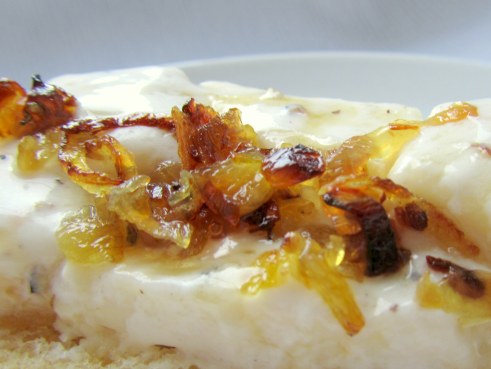
Nowadays, you can get decent (and indecent, for that matter) Manchego cheese in almost every supermarket. But, Idiazábal cheese is only to be found in high end delicatessen shops, at the price of an arm, a leg, and your children corneas. I only remember having it once in the 9 years I have been living in Switzerland, and truth to be said, it was a Spanish acquaintance who smuggled it in gruyère -land.
In case you are wondering, Idiazábal is a Denominación de Origen [Protected designation of origin] hard sheep cheese from the Basque and Navarre regions, which has a rich smoky flavor. Apparently, the Basque shepherds used to store the cheese in their huts over Winter. The smoke coming out of their fireplaces eventually permeated their dairies, giving it a new flavor that the shepherds preferred. All I can say is that the flavor (and aroma) is strong. Very strong…
In fact, so strong I thought my suffering testers dinner guests wouldn’t appreciate it to its full splendor. I resorted to Simone and Inés Ortega’s The Book of Tapas for help, and as it turned out, it was actually a very good idea to serve this tapa rather than the pure thing. The sweetness of the onion and honey complement to perfection the slightly less smokey and hot-ish flavor the cheese, for complete delight of guests and cook.
Idiazábal cheese and caramelised onion tapa (adapted from Simone and Inés Ortega’s The Book of Tapas)
Ingredients
- 200g Idiazábal cheese, rind removed and sliced
- 1 cup (=250mL) milk
- 2 teaspoons black peppercorns, slightly crushed
- 1 cup olive oil
- 1 onion, finely sliced
- 6 slices of French baguette
- 1 teaspoon honey
Method
1. Put the cheese in a bowl, add the milk and the crushed peppercorns. Let it sit for about 30min (until it is a bit softer)
2.In the meanwhile, heat the olive oil in a non-adherent frying pan until it shimmers. Drop in the onion, and let it caramelise, stirring every now and gain.It should take about 15min.
3. Fish the cheese out of the bowl and pat dry with kitchen paper.
4.Place each slice of cheese on top of the bread and drop about 1 teaspoon of the caramelised onions over it. Finish the tapa by drizzling a little honey over it.
Savoury tuna parcels (empanadillas de atún)
Posted: January 21, 2012 Filed under: Fish, Pastry and Baking | Tags: Carlos Horrillo and Patrick Morcas, Finger food, Pastry, Snack, Spain, Tomato, Tuna fish 3 Comments
Another Spanish classic… Very much like the tortilla de patatas [potato omelette], there are many versions and interpretations. And, as you might guess from previous posts, the best empanada is going to be the one cooked by the proverbial Mother-in-Law… Actually, at some point, I had scribbled down a recipe that had been in someone’s family for generations. But hélas!, I lost it during one of my many moves. I ended up to use the one Carlos Horrillo and Patrick Morcas have on their Tapas: Simple Flavours, Striking Combinations book.
All in all, it is not exactly easy to get this dish right. The filling is relatively straightforward, but the pastry requires a certain level of skill and commitment. Although this might sound like scratching a chalkboard with nails to some, I ended up using pre made pastry, to avoid any culinary catastrophes… In any case, it is an awesome combination of flavors and textures, which reminds me of home and many bohemian nights out.
Savory tuna parcels (empanadillas de atún)
For the filling
- Olive oil
- 2 medium onions finely sliced
- 1 large red pepper, finely chopped
- Salt and black pepper to taste
- 225g tomatoes coarsely chopped
- 350g of good quality tuna (in olive oil), drained
- 8-10 good quality black 0lives, stones removed
- Small pinch of saffron strands. soaked in 2 tablespoon hot water
For the pastry
- pack of ready rolled puff pastry
- 1 beaten egg
Method
Place a large heavy base, non stock frying pan (or wok) on a low heat with 8 dashes of olive oil. Add the sliced onions and pepper, a pinch of salt and pepper then sauté gently until soft and tender.
Add the chopped tomatoes and give everything a good stir, then simmer gently until all the ingredients have reduced to a thick sauce.
Add the tuna, olives, saffron and another pinch of salt and pepper, Summer everything together, stirring regularly until you have a tick, rich sauce. Set aside to cool, and then refrigerate for 2 hours.
Preheat your oven to 200oC/400oC/gas mark 6
Lightly flour your work surface and place the rolled puff pastry on top. Using a sharp knife, cut the pastry into 12cm squares and arrange them on several greased baking sheets. You will need 8-12, depending on how many people you are going to serve. Gauge it so you have enough pastry to wrap the filling. If the pastry is too thin the parcel will burst and all the ingredients will spill out. Some spillage is fine. If the pastry is too thick, it will not allow the flavours of the filling to come through.
Put a dollop of the tuna mixture, a ball shape roughly 5-6cm, in the middle of the square, and then dab the edges of the suare with eaten egg, Bring up the corners of the pastry to the centre and press them together to form a peak at the top. Glaze the tops with beaten egg, and then in the oven for 20min, or until golden brown. Serve hot, warm or cold.
Alternatively, you can put the pastry in the a rectangular or square baking tray, allowing the wall to be coated about 5cm. Put the tuna mixture on it, and put another sheet of pastry on top. Close the edges, sealling with beaten egg. Glaze the top with beaten egg.
Anchovy, hard boiled egg and caper on toast (pintxo de anchoas)
Posted: September 28, 2011 Filed under: Eggs, Fish, Snacks | Tags: Anchovies, bread, Spain Leave a comment
In a literal manner, tapa means a cover or lid in Spanish. But, if you are talking about food, a tapa refers to a range of fine appetizers and nibbles that are served in bars and pubs to accompany a glass of wine or beer. Over the years, tapas have evolved into a completely new concept, being now a synonym of miniature dishes – sometimes very sophisticated – which are put together to form a meal. In any case, tapas, or its closely related pintxos and raciones, are the center of informal meals and allow you to focus on chatting and socializing rather than scoffing a full blown dinner.
Even risking sounding a bit pedantic, the dish I am doing today is a pintxo. Traditionally, this combination with anchovies is ubiquitous in the Basque Country. And, you simply are not not served tapas in the Basque Country. Up the there, the pieces of bread with something on top are called pintxos. Incidentally, unlike other parts of the country, you also have to pay for them. In case you wonder, about.com does a excellent job on explaining with great detail and accuracy what is one or the other, and the difference between them.
As of late, I have been kind of missing this sort of flavors from home… A poker night presented itself like the perfect opportunity to give it a go. After googling a bit, I ended up finding this Spanish blogger from Bilbao, whom had a recipe that looked very much like the pintxos de anchoa you can find all over the Basque Country.
Anchovy, hard boiled egg and caper on toast (pintxo de anchoas)
Ingredients
- 150 grs. of cream cheese, like Philadelphia
- 2 tins of salted anchovies
- Sliced bread (I use the equivalent of a French bagette, cut diagonally).
- 2 hard boiled eggs, chopped very finely.
- Capers or sliced gurken
- Olive oil
Method
Put the cheesed and the anchovies (plus its olive oil). Mix well with a blender until you obtain a homogenous mix. Reserve.
Cut the bread crust out, and cut each slice in half so you can obtain 2 rectangles. Fry in a generous quantity of olive oil. Be careful to not let the olive oil overheat to avoid the bread to burn. I was on a hurry this day, and simply toasted the bread until it was crunchy. This version is also less caloric.
Spread a generous quantity of anchovy mix so you obtain a thick layer on top of the bread. Cover with the egg and put a couple of cappers on top of it.
La Miranda de Secastilla, 2007
Posted: April 2, 2011 Filed under: Wine | Tags: Spain, Wine Leave a comment

Piedra Lagar 2008
Posted: January 3, 2011 Filed under: Wine | Tags: Spain, Wine Leave a comment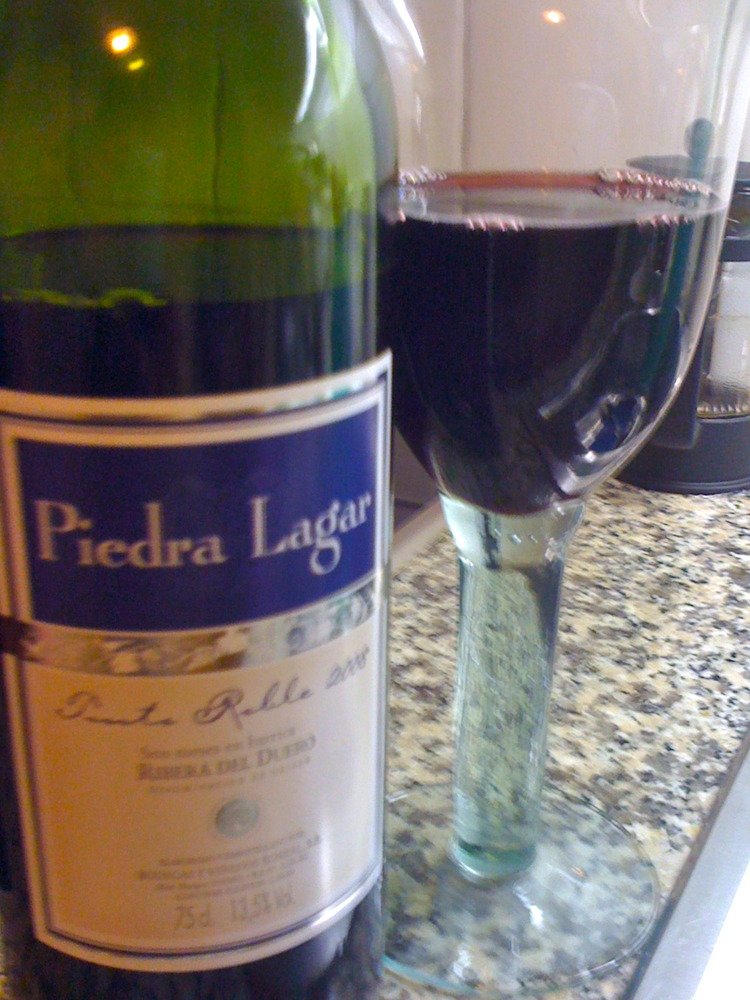
A lovely Ribeira del Duero: Piedra Lagar Tinto Roble 2008. It was highly recommended by the owner of Ugarte, a small Spanish wine shop in Zurich. It was just one this wines that has different flavors as you taste it, from fruity to peppery.
Pan fried chorizo with roasted peppers and Fundador Brandy
Posted: December 8, 2010 Filed under: Sausages | Tags: Carlos Horrillo and Patrick Morcas, chorizo, Red pepper, Spain Leave a comment
Another recipe from one of my favorite cook books: Tapas: Simple Flavours, Striking Combinations by Carlos Horrillo and Patrick Morcas. You can use any brandy, really, but only Fundador Brandy gives it a special flavor. Needless to mention some caution is needed while flambée-ing.
Pan fried chorizo with roasted peppers and Fundador Brandy
Ingredients
- 2 medium red peppers
- Olive oil
- Garlic infused oil (just mix garlic to taste with olive oil, mix and let rest for a few hours).
- 8 spice chorizo sausages (if you want to be very precise, you should look for Rosario chorizos), cut into 2cm slices
- 50ml Fundador Brandy
- parsley, roughly chopped
Method
Spike the 2 peppers with skewers and hold them over a high flame on the stove until the skin is charred and black. Leave the peppers to cool down a bit, then peel of the skins and hull them (for practical reasons, I never do this. Probably, I get a more rustic dish).
Place 2 dashes of olive oil in a heavy based frying pan and put on at medium heat. Add the skinned peppers and sear them quickly all over. Remove them all over and put them in a dish. Sprinkle over some garlic infused olive oil and salt, allow them cool and then cover the dish with clingfilm and leave to marinate in the fridge for a couple of hours.Once done, cut the peppers into slices and leave to one side.
Place a clean large heavy-based frying pan (or wok) on a high heat. Add 2 dashes of olive oil and tilt the pan backwards and forwards to coat the base completely. When to oil is smoking hot, drop in the sausages and cook fiercely until they start to brown and release their fat. At this point put the sliced marinated peppers and cook for 20 seconds more. If you are cooking on gas, be careful. The fat will spit and might ignite. Put in the Brandy – it is very likely that the pan will ignite. If not, just use a match to start the flambee. Let it cook for 10 seconds, or until the flame is gone. Then toss in the parsley. Serve right away.
Tortilla de patata [Spanish omelette]
Posted: September 28, 2010 Filed under: Eggs, Vegetarian | Tags: Carlos Horrillo and Patrick Morcas, Omelette, Potatoes, Spain 1 Comment
No matter how much effort, love and care you put into it, someone mother’s tortilla will be always better than yours. And don’t even mention the supreme interpretation of this Spanish classic done by all Mothers-in-Law – specially yours. To stay away from trouble, I use the recipe I found in the book: Tapas: Simple Flavours, Striking Combinations by Carlos Horrillo and Patrick Morcas, and call it potato and caramelized onion omelette.
Tortilla de patata [Spanish omelette]
Ingredients
- 1.5 Kg Desiree red potatoes (I use 1Kg of parboiled roesti potatoes. Most Spanish Mothers and Mothers-in-Law would be horrified if they knew).
- Olive oil
- 1 large Spanish onion (always a controversial topic. For some, a proper tortilla de patata has nothing but eggs and potatoes; others would call the thought an heresy).
- knob of butter
- 10 eggs (no typo: it is indeed ten eggs you are going to need).
- Salt and pepper
Method
Peel the potatoes, cut them in half, and then cut each half into slices 1.5cm thick. Place in a pan of cold, salter water ad bring the to the boil. Parboil, or until just tender enough to pierce with a knife. Drain and leave to one side.
In a large, non-stick frying pan, around 30cm in diameter (preferably with slopping side because it will make turning the tortilla easier later on), place 12 dashes of olive oil and put on a low to medium heat (this is liberal quantity of olive oil – enough to cover the bottom of the pan with a thick film). Toss in the sliced onions and a generous pinch of salt and pepper, and start to fry them. Once the onions start to sizzle, turn the heat down to low and add the knob of butter. Cook the onions until they are soft and golden, and then remove them with a slotted spoon and place to one side.
Return the pan to medium heat, and add the par-boiled potatoes, a generous pinch of salt and a small pinch of pepper. Fry gently for 2 minutes, turning frequently or until the potatoes are lightly crisp and and golden on the outside while soft on the inside. Just before they are done, return the onions to the pan, stir them well and cook them together for about a minute. When done, remove everything with a slotted spoon and place in a bowl to one side. You will need the oil that was left at the pan for later.
Crack the eggs into a large bowl, add 2 generous pinch of salt, a small pinch of pepper and beat lightly together. Add the cooked potato and onion mixture and still well. Leave to stand for a few minutes, to allow the ingredients to marry.
Return the pan to medium to high head, add 6 more dashes of olive oil (again, until you have a thick oil film that covers the surface of the pan. Tilt the pan until the bottom is well coated. Do not forget to do is, or else you have parts of the tortilla firmly sticked to the bottom of the pan. Not a nice tortilla technique…). Heat the oil until smoking hot, then poor in the egg mixture, moving the pan in a gentle, circular motion to distribute the ingredients evenly and prevent the eggs to stick and burn. Cook for about 30 seconds, then turn down the heat to medium low, and cook for further 4 minutes, shacking the pan gently every so often. Do not stir! (Seriously, do not! If you stir, it will be a completely different dish). When the tortilla start to bubble on the side, it is time to turn over. If this the first time at doing this, prepare for a mess (let’s face the facts – it will get messy. It took a few times before Mr Burntsugar got the hang of it, but now he is an expert. I am more on the supervision and management side of things).
Find a suitable plate, large enough to cover the face of the pan with space to spare, and sit it face down on top. Hold firmly onto the handle of the pan with one hand and use the other hand to press down firmly the plate. Now, in one fast move, lift the pan of the stove and flip it over onto the plate. Remove the pan (hopefully, there’ll be little, if anything, left stuck to the base, and not a horrible mess to clean in the kitchen). Clean thoroughly the pan with kitchen paper roll. It is very important the bottom of the pan has no egg leftovers and burnt egg stick to it. Set down the pan while you add 12 more dashed of olive oil and tilt the pan to make sure the bottom is coated with a thick film of olive oil. When the oil is smoking hot, carefully slide the half cooked tortilla into the pan to cook on the other side. You might need to shake the pan gently and tuck in the sides of the tortilla with a wooden spatula because they will probably look a bit jagged. Allow the tortilla to cook in hight heat for about 30 seconds, then reduce the heat to medium low heat and cook for further 4 minutes. This should leave you with a tortilla moist in the middle (when the tortilla is this cooked to its point is another heated controversy). If you are the ones who prefer it firmer, cook it for a few minutes more, preferably before carbonization. When the tortilla is cooked to your taste, slide it onto a clean plate to cool down slightly. Serve it warm, at room temperature, cut in slice, in little cubes…
 Lucie Loves Food