Inspired by a moussaka
Posted: October 13, 2011 Filed under: Beef, Vegetables Leave a comment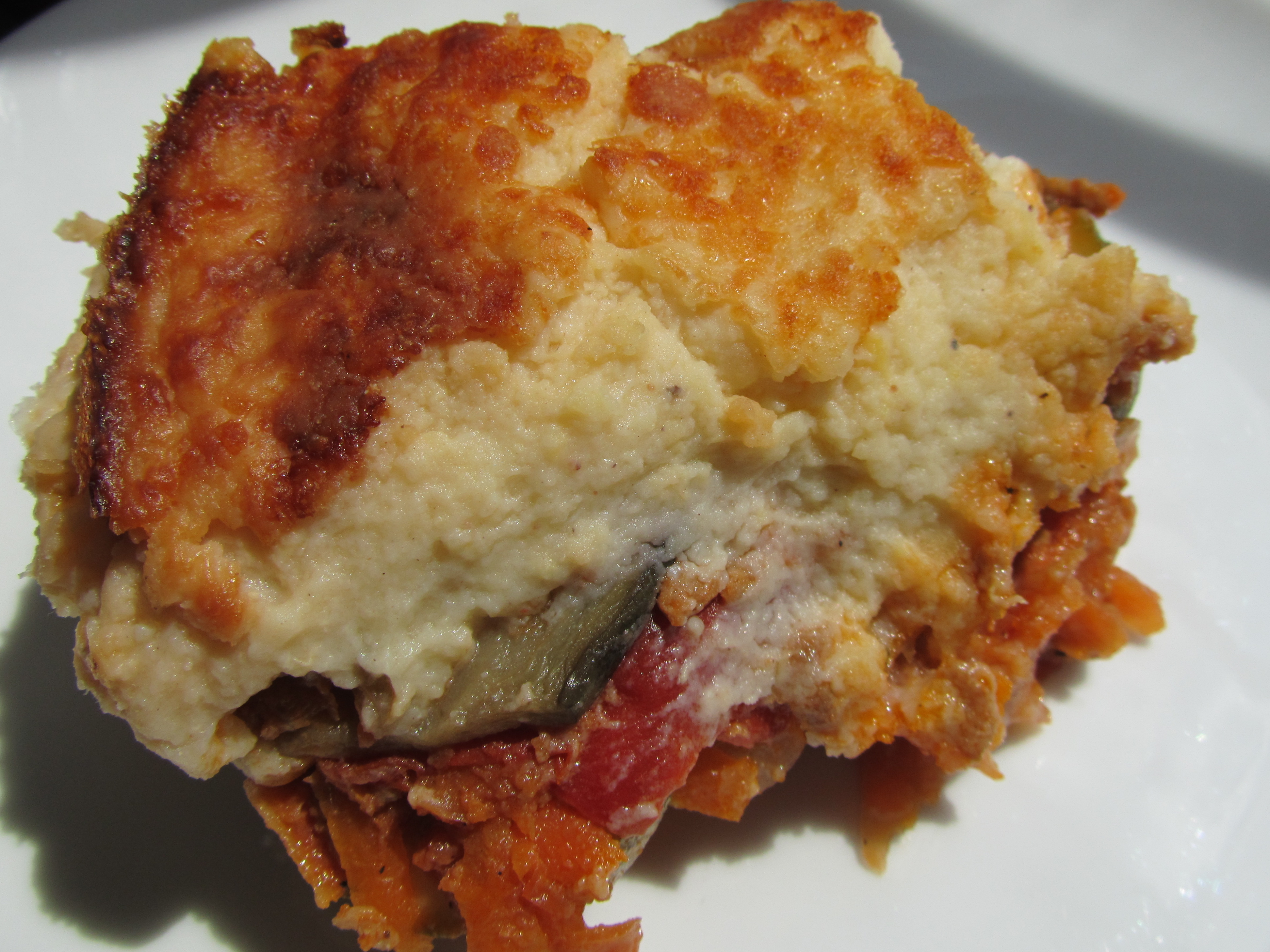
It all started with a Masterchef Australia Masterclass. One of the chef hosts, George Calombaris, of Greek descent, invited his mother, Mary, to show how to do a proper moussaka. Mrs Calombaris taught George to cook the way that her mother had taught her. Her mother’s mother thought her daughter to cook the way her mother had taught her. And her mother’s mother’s mother… The thing is that Mrs Calombaris is adamant on keeping the dishes faithful to the tradition. Any modification on the original recipe is taken as major offense – and Mrs Calombaris won’t hesitate to scold George for bastardising traditional Greek dishes. Actually, it sounds a lot more like yelling at him, while he just rolls his eyes.
When I started cooking the moussaka, I already had a minor modification in mind: the cheese. Mrs Calombaris’s recipe calls for kefalograviera, which is impossible to source here. It ended up being replaced by less the less greek grana padano – another tasty hard cheese. Then the full cream milk was replaced by less fatty milk. And, the lamb, pork and veal mince give place to beef and pork. Followed by replacing the tomato passata by Portuguese tomatada. Now that we were at it, I pulled a few zucchini I had languishing in the bottom of the fridge. In less time it takes to write it, I had totally bastardized a Greek classic… no way I would call this a moussaka. I was even feeling Mrs Calombaris reprimands on the back of my mind. So, here it is: a seriously good dish, just perfect for a cold Winter nights, inspired by a moussaka. It just warms you until your heart.
Inspired by a moussaka
Ingredients
- ¼ cup olive oil
- 3 aubergines, peeled vertically like a zebra and sliced 5mm thick
- 3 zucchini sliced 5mm thick
- 500g pork and beef mince
- 1 onion, finely diced
- 2 cloves garlic, finely diced
- 1 tablespoon dried oregano
- 1 tablespoon thyme, chopped
- 1 tablespoon rosemary, chopped
- 2 cinnamon sticks
- 250g crushed tomatoes
- 400g tomato sauce (it can be replaced by 400g tomato passata)
- 2 tablespoons tomato paste
- 1 ½ cups water
- Olive oil, for frying
- 4 large potatoes, sliced 5mm thick
For the bechamel
- 100g butter
- 100g plain flour
- 600ml (full cream milk), warmed
- 100g grana padano, grated
- 1 egg
- Extra grana padano cheese, grated
Method
1. Preheat oven to 180⁰C.
2. Lay the aubergines over a shallow tray or dish and sprinkle liberally with salt. Cover with muslin or a clean tea towel and set aside for 30 minutes.
3. Heat oil in a large frying pan or saucepan, add the minced meat and cook until browned and meat breaks up. Add onion and sauté until softened. Add garlic, oregano, thyme, rosemary and cinnamon quills and allow to cook for 3-5 minutes, stirring occasionally.
4. Add crushed tomatoes, tomato passata, tomato paste and water, bring to the boil, reduce heat to low and simmer for ½ hour. Season with salt and pepper to taste.
5. Pour oil into a frying pan approximately 1cm deep, place over a high heat and shallow fry potatoes for 3-4 minutes on each side or until tender. Drain on paper towel.
6. Pat dry the aubergine and pan fry on each side until golden yet still firm. Drain on paper towel.
7. Pat dry the zucchini and pan fry on each side until is soft. Drain on paper towel.
8. For béchamel, melt butter in a heavy based saucepan. Add flour, stir over a low heat for 2 minutes.
9. Slowly add warm milk, stirring continuously until thick. Add extra milk if sauce is too thick.
10. Whisk in the cheese and the egg, season to taste.
11. To assemble, oil a casserole dish and layer as follows. Meat sauce, potato, sauce, potato, sauce, zucchini, sauce, potato, aubergine and remaining sauce. Cover with béchamel and grate extra cheese over.
12. Bake for 45 minutes until browned and béchamel has set. Serve.
Crushed courgettes and roasted chicken
Posted: September 26, 2011 Filed under: Chicken, Vegetables | Tags: Courgette, Garlic, Herbs, Masterchef Australia, Yotam Ottolenghi, Zucchini Leave a comment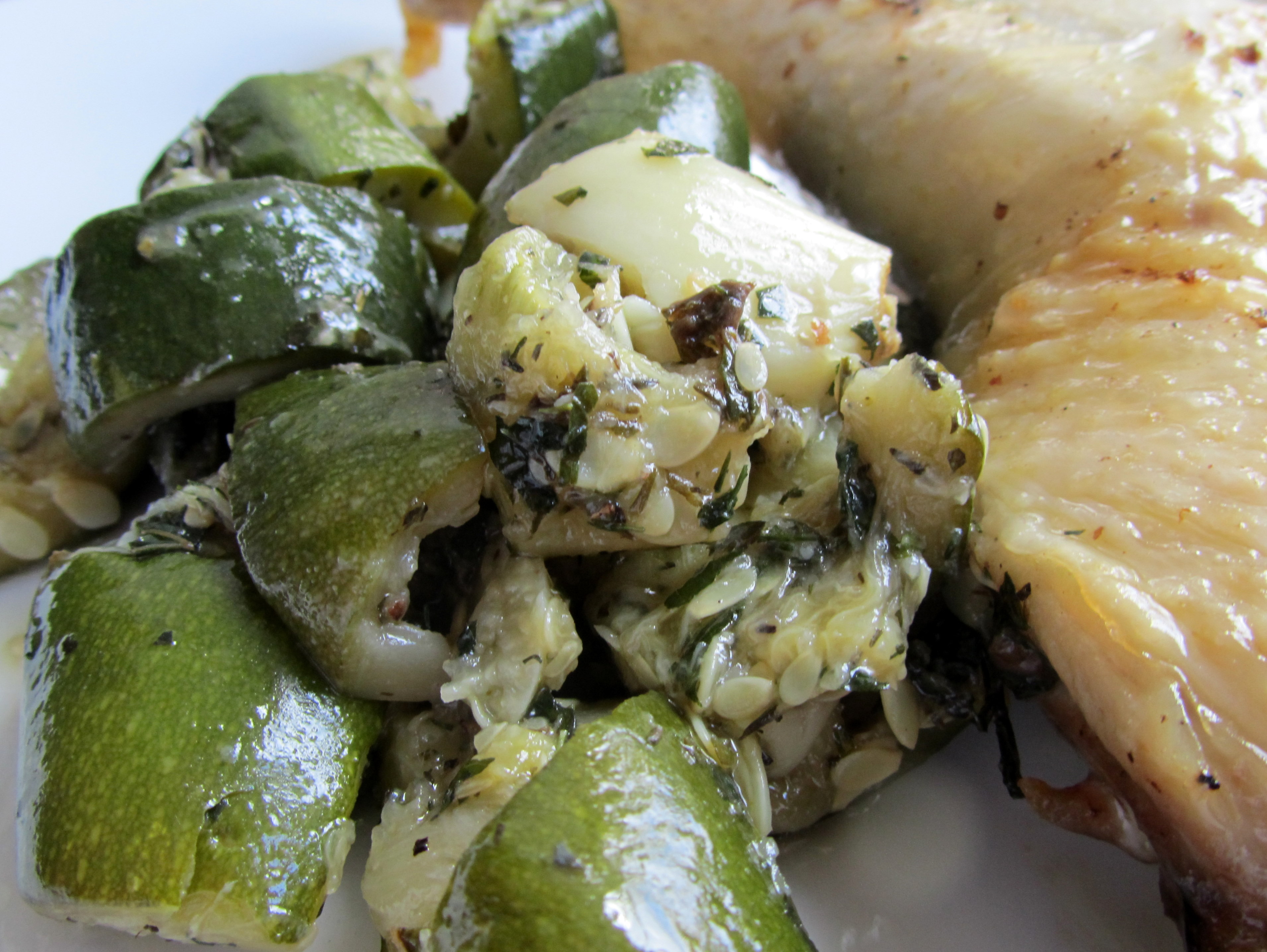
In a couple of weeks, courgettes’s season will be almost over. But, for the time being, we still can find them at the supermarket screaming to be cooked with loads flavors to soak up. For example – garlic, thyme and mint, as in this crushed courgettes dish Yotam Ottolenghi created for The New Vegetarian.
To go with the courgettes, nothing better than a roasted chicken. For this one, I used a very basic recipe I saw on Masterchef Australia (with a couple of tweaks).
Crushed courgettes
Ingredients
- 3 large courgettes (750g), cut in half lengthways and then into 6cm pieces
- 1 whole garlic bulb, separated into unpeeled cloves
- 1 tsp dried mint
- 3 sprigs fresh thyme
- 1½ tsp coarse sea salt
- Black pepper
- 70ml olive oil
- 2 tbsp chopped fresh mint
- 1½ tbsp chopped dill
- 1 tbsp lemon juice
Method
Heat the oven to 200C/400F/gas mark 6. Put the courgettes and garlic cloves in a bowl and add the dried mint, thyme, salt, some black pepper and the oil. Mix everything together and transfer to a medium baking dish – make sure the courgette pieces overlap a little, cut side up, and form a single layer. Bake for about 40 minutes, until the courgettes have softened and taken on some colour.
Transfer everything to a colander, pressing the courgettes so they start to release some of their liquid, and leave to cool for at least 30 minutes.
Transfer the contents of the colander to a mixing bowl, and squeeze the garlic cloves out of their skins (discard the skins). Mash everything together with a fork (if the courgettes’ skin is on the tough side, you may have to chop them with a knife). Stir in the remaining ingredients and set aside for an hour before serving.
Roasted chicken
Ingredients
- 1 chicken, broken down into legs & breasts still on the bone
- 8 sprigs of rosemary
- Olive oil
- Salt and pepper to taste
Method
Preheat the oven at 220oC
Cover the bottom of a roasting tray with olive oil. Put the chicken into the tray skin, with the side up in one evenly spread layer.
Pat the chicken skin with a paper towel until it is dry. Sprinkle evenly with salt and pepper and drizzle with olive oil. Put the rosemary on top of the chicken pieces.
Put the tray into the oven, and cook the chicken for about 35min.
Pizza Bianca with Potato and Anchovies
Posted: September 23, 2011 Filed under: Fish, Vegetables | Tags: Cheese, Fish, Herbs, Masterchef Australia, Pizza, Potatoes, spinach Leave a comment
You don’t like tomato sauce on your pizza? Don’t worry, we have have something for you: a pizza bianca, courtesy of Gary Mehigan and Masterchef Australia This elegant combination of flavours and textures is so good, you will have you wish you had made two pizzas. The Classic Pizza Margherita is good, but this one is something else…
Pizza Bianca with Potato and Anchovies
Ingredients
- semolina and plain flour, for dusting
- 1 x 120g dough portion (I used already made pizza dough)
- 1 garlic clove, peeled and bruised
- 3 sprigs rosemary
- ¼ cup extra virgin olive oil, plus extra for brushing
- ½ cup Parmesan cheese, coarsely grated (I replaced it with granna padano)
- ½ cup aged provolone, coarsely grated (I replaced it with Gruyere)
- 1 waxy potato, such as Desiree, very thinly sliced
- ¼ cup wild rocket leaves, washed, drained (I replaced it with baby spinach)
- 60g buffalo mozzarella, torn
- 6 anchovy fillets (optional) (only had anchovy filled with cappers, so used it instead).
Method
Place an unglazed terracotta tile into an oven and heat to 250°C. Sprinkle a clean work surface with semolina and flour and use your fingers or rolling pin to stretch out the dough until about 25cm in diameter or to desired thickness. Dust a wooden paddle or sheet of baking paper with semolina and flour and place dough on top.
Step 2: In a small bowl add garlic, 1 sprig of rosemary, 2 tablespoons of oil and a pinch of salt. Brush the dough with the oil.
Step 3: Combine cheeses and scatter over dough, leaving a 1cm border around the edge. Strip leaves from remaining rosemary and sprinkle over dough.
Step 4: Lay the potato slices evenly over the dough. Brush with oil and sprinkle with sea salt flakes.
Step 5: Slide pizza onto hot terracotta tile and bake for 5-6 minutes or until golden and crisp. Remove pizza from oven. Brush the crust with olive oil.
Step 6: Mix rocket with remaining olive oil and a pinch of salt in a bowl. Scatter mozzarella, anchovies, and rocket over pizza. Season with freshly ground black pepper and serve.
Baked salmon with fennel and tomatoes
Posted: September 21, 2011 Filed under: Fish, Vegetables | Tags: BBC GoodFood, Fennel, Lemon, Salmon, Tomato Leave a comment
If you are about my age, and studied organic chemistry, there is a very big chance one of your lab practices was the synthesis of anisaldehyde, a chemical compound which is found in anise, tastes like licorice and smells of sweet almonds. I don’t recall it as being excessively difficult, but what made this lab memorable was the strong aniseed smell of the whole experiment. It was like a haze that would stay with you for a couple of days, and sort of thing that would put you off of anything that might resemble it. For example, licorice, almond oil or even amarguinha, a Portuguese almond liqueur. Later, in my short (but intense) academic career, I ended up using anysaldehyde in my experiments for a good 4 years. It still smelled the same, and it still would give me headaches.
Needless is to say, my motivation for using anything that might be slightly aniseed was almost non existing. But, one day I took a picked a bit fennel salad in a buffet. And, much to my surprise, it tasted good. It was crunchy, fresh and it had a slight taste of anise, that just made it a bit more interesting. A vegetable you could see in a salad during Summer, or in a more autumnal roast. Or, all year round paired with fish – a combination of flavors made in heaven.
The recipes of salmon-cherry tomato-fennel are ubiquitous. For this dish, I turned to BBCGoodFood, for no special reason other than being a todpop‘s favorite.
Baked salmon with fennel and tomatoes
Ingredients
- 2 medium fennel bulbs
- 2 tbsp chopped flat-leaf parsley
- zest and juice 1 lemon
- 175g cherry tomatoes
- 1 tbsp olive oil
- 2 salmon fillets , about 175g each
- few black olives (optional)
Method
Heat oven to 180C/fan 160C/gas 4. Trim the fronds from the fennel and set aside. Cut the fennel bulbs in half, then cut each half into 3 wedges. Cook in boiling salted water for 10 mins, then drain well. Chop the fennel fronds roughly, then mix with the parsley and lemon zest.
Spread the drained fennel over a shallow oven proof dish, then add the tomatoes. Drizzle with olive oil, then bake for 10 mins. Nestle the salmon among the veg, sprinkle with lemon juice, then bake 15 mins more until the fish is just cooked. Scatter over the parsley and serve.
Grilled aubergine with tahini dressing
Posted: September 12, 2011 Filed under: Vegetables, Vegetarian | Tags: Aubergine, Gordon Ramsay, Herbs, Tahini Leave a comment
A super easy and quick dish, perfect for a hot Summer day: grilled aubergine finished with a creamy tahini dressing, by the great Gordon Ramsay . It looks a pale shadow of the sabih, tahini sauce and zhoug dish I tried earlier this Summer, but on its simplicity it is an elegant (and) delicious dish that goes well as a salad, entrée or put on the side.
Grilled aubergine with tahini dressing
Ingredients
Grilled aubergines
- 1 large aubergine trimmed
- olive oil enough to brush and drizzle
- sea salt and black pepper
- few rosemary springs, plus extra to garnish
- 3 bay leaves, plus extra to garmish
- Juice of 1/2 lemon
Tahini dressing
- 1 tablespoon tahini paste
- 2 tablespoos of natural yogurt
- 1 tablespoon lemon juice
- 1 tablespoon runny honey
- 1 garlic clove, peeled and finely crushed
Method
Cut the aubergine into 1 cm thick slices. Generously brush with olive oil on both sides and tub all over with salt and pepper. Toss with the rosemary and the bay leaves
Heat a griddle pan, then add the aubergine slices with the herbs. Griddle for 4-5min on each side until cooked. Transfer to a serving bowl and while still warm, drizzle over some more olive oil and the lemon juice. Toss well to coat and set aside to cool.
For the tahini dressing, mix all ingredients together in a bowl until smooth. Stir in 1-2 tablespoons of hot water to loosen the dressing until it is of the consistency of double cream. Season to taste with salt and pepper.
Drizzle the dressing over the grilled aubergine and garnish with a few fresh bay leaves and rosemary springs.Serve with some warm flat bread on the side.
Pan fried chicken with a white wine, mushroom and tarragon sauce
Posted: September 9, 2011 Filed under: Chicken, Vegetables, Wine | Tags: Chicken, Mushrooms, sauce, tarragon, Wine Leave a comment
A confession – this dish is not my creation but have no idea where the recipe comes from… I found it some place lost in The Internets, made the dish and forgot to bookmark it. By the time I wanted to cook it again, was not able to find it and the details had washed away. So, I kind of have to recreate it from memory. After all, it is a good Summer dish. The white wine and tarragon flavors combine for a light and fragrant sauce, which compliments the chicken perfectly. Caramelising the onions with the star anise makes them feel meatier, a trick I have learnt from George Calombaris during one of his Masterchef Australia’s Masterclass. I found it had to believe, but it works and slightly aniseed flavor is also a bonus.
Pan fried chicken with a white wine, mushroom and tarragon sauce.
Ingredients
- 2 Chicken thighs
- Flour (I used Maizena)
- 4 Medium size yellow onions, sliced in half-moons
- 3 Star anise
- 1 Clove of garlic
- 500g Button mushrooms, cut in 2cm slices
- Tarragon to taste finely chopped (I used about 4 bunches)
- 100mL dry white wine
- 200mL chicken or vegetable stock
- Salt and pepper to taste
- 4-5 tablespoons of olive oil.
Method
Dip each chicken drumstick in the flour, salt and pepper to coat them lightly. In a sauté pan, put the equivalent of 2 tablespoons of oliver oil over medium-high heat. When it is shimmer, add the chicken thighs, and cook them for about 3 minutes on each side, until they get a little golden. Take them out from the heat and reserve.
In the same pan, put the sliced onions and the star anise, salt and pepper. Let it caramelise for about 15min, or until they are soft and translucent. Once they are ready, take them out from the heat and reserve.
While the onions are cooking, heat the equivalent of 2 olive oil tablespoons in another sauté pan. When the olive oil starts to shimmer, fold in the sliced mushrooms. Cook, stirring often, until lightly browned (about 15min). Take them out from the heat and reserve.
In the same sauté pan you cooked the chicken thighs and the onions, put the 100mL of wine to deglaze. Let the wine reduce on a medium heat, and then put in the mushrooms and onions . Mix well to combine and let them absorb the wine for 5min. Put the chicken thighs in, and add enough stock to cover them. Once the stock is bubbling, fold in the tarragon. Let it is simmer for about 30min or until the stock is almost totally evaporated
Classic Pizza Margherita
Posted: September 7, 2011 Filed under: Vegetables, Vegetarian | Tags: Gary Mehigan, George Calombaris, Herbs, Masterchef Australia, Mozzarella, Pizza, Tomato 1 Comment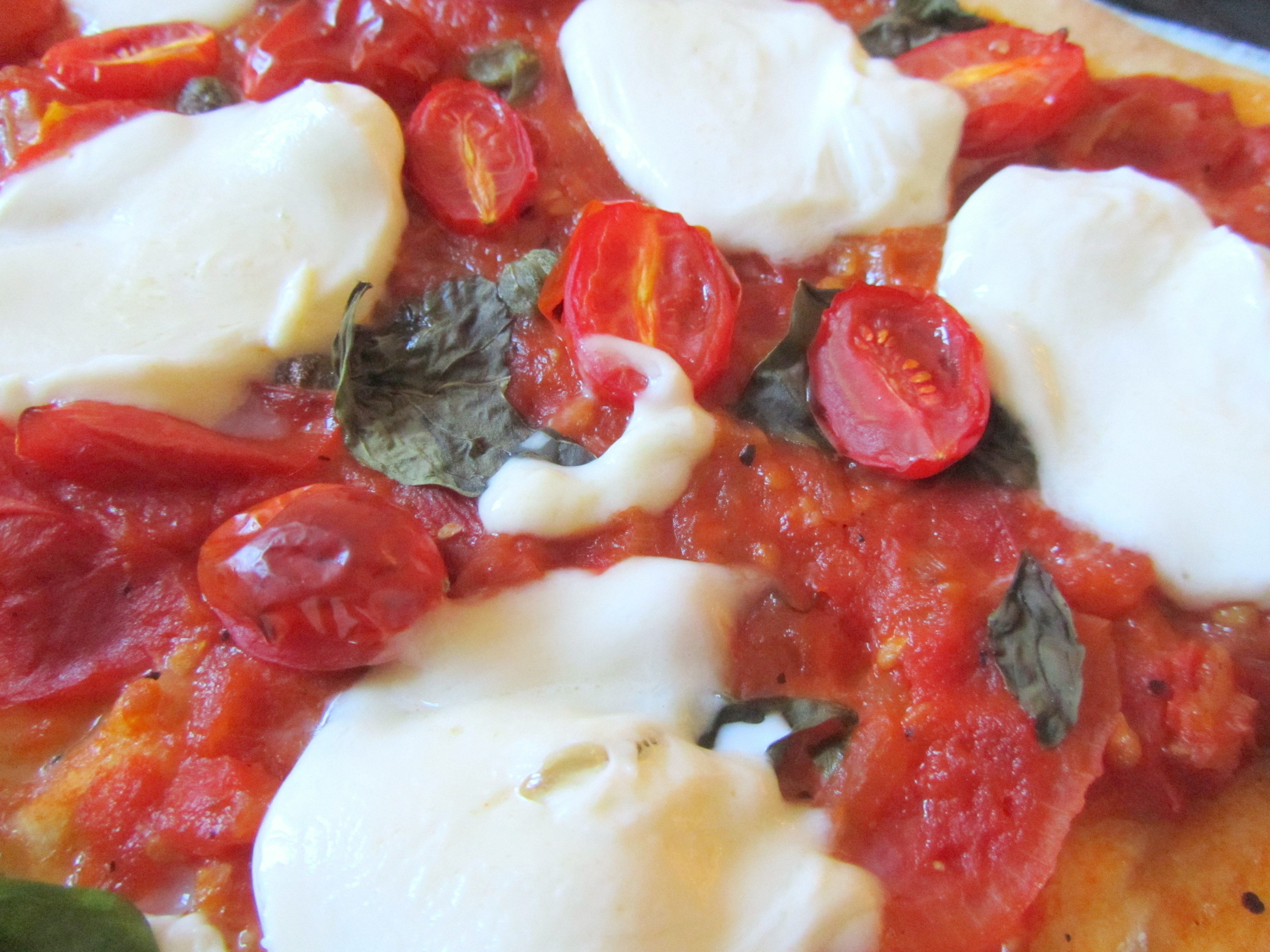
Pizza – enough said. For a quick meal and trying to keep the 11-year-old happy, I gave a go to the pizza Margherita recipe George Calombaris demonstrated during a Masterchef Australia’s Masterclass. A classic combination, which was as named after the Italian queen who first tried (and loved) the tomato, mozzarella and basil in a pizza bread.
To cook this pizza, I took a short cut that is generally a no-no for a high-class number, and used already-made dough. But, if you feel you have bake your own pizza dough, here is an recipe, also from Masterchef Australia. Also, instead of sticking to pizza sauce, I just took a jar of tomatada [Portuguese style tomato sauce] I had sitting in the fridge and put it to good use.
George and Gary (Mehigan) have another trick to bake a crispy dough for the perfect pizza. To distribute the heat evenly across the pizza base and to extract the moisture, place an unglazed terracotta tile into an oven and heat to 250°C. (I didn’t – if only I knew where to find terracota tiles in Zurich which doesn’t cost the equivalent of a 100g of white truffle).
Classic Pizza Margherita
Ingredients
- 3 tablespoons of olive oil
- 2 medium yellow onions cut in half lengthwise and sliced into thin half moons
- 2 springs fresh flat leaf parsley
- 1 bay leaf
- 2 garlic gloves minced
- 1 kg very ripped tomatoes, seeded and chopped* (or a couple of canned tomato, preferably san marzano, chopped, juices reserved).
- 2 to 3 tablespoons of double concentrated tomato paste, to taste
- 1 small fresh medium red hot chilli pepper, such as Serrano, stemmed, seeded and chopped (it is optional. Sometimes, I just add a few drops of piri piri sauce).
- Freshly grounded salt and black pepper to taste.
- 1 x 120g pizza dough portion (I use already-made pizza dough)
- Plain flour, for dusting
3 tbs pizza sauceTomato sauce to cover the base- 1 tbs baby capers, rinsed and drained
- 6-8 large basil leaves
- 9 halved oven-roasted cherry tomatoes
- 2 tbs extra virgin olive oil
- 50g buffalo mozzarella, torn
Method
Tomato sauce
Heat the oil in a large frying pan over medium heat until it shimmer. Add the onions, parsley and bay leaf and cook until nicely golden, about 15min. Add the garlic and cook for 1 min more.
Turn the heat to medium low, stir in the tomatoes and their juices, the tomato paste and chilli pepper, if using. Bring to a simmer, cook, lid ajar, stirring occasionally, until the tomatoes break down, about 30min
Toss out the parsley and bay lead and season with salt and pepper. If you wish, you can scrape the sauce into a food processor and buzz until smooth. Store the sauce in the fridge in a glass jar with a tight-fitting lid for up to 1 week. It can also be frozen for up to 2 months.
Pizza
On a floured wooden paddle or piece of baking paper, stretch out the dough into a long oval shape about 30cm long and 10-15cm wide, or to desired shape and thickness.
Spread the tomato sauce over the dough, sprinkle with baby capers and scatter over basil leaves. Place cherry tomatoes on top and drizzle with olive oil.
Slide the pizza into the stove and bake for about 5 minutes or until golden and crisp.
Brush the crust with olive oil and scatter mozzarella over pizza.
Beef stew with mushrooms and vegetables
Posted: August 30, 2011 Filed under: Beef, Vegetables | Tags: Beef, Courgette, Mushrooms, Red pepper, Stew, Zucchini Leave a comment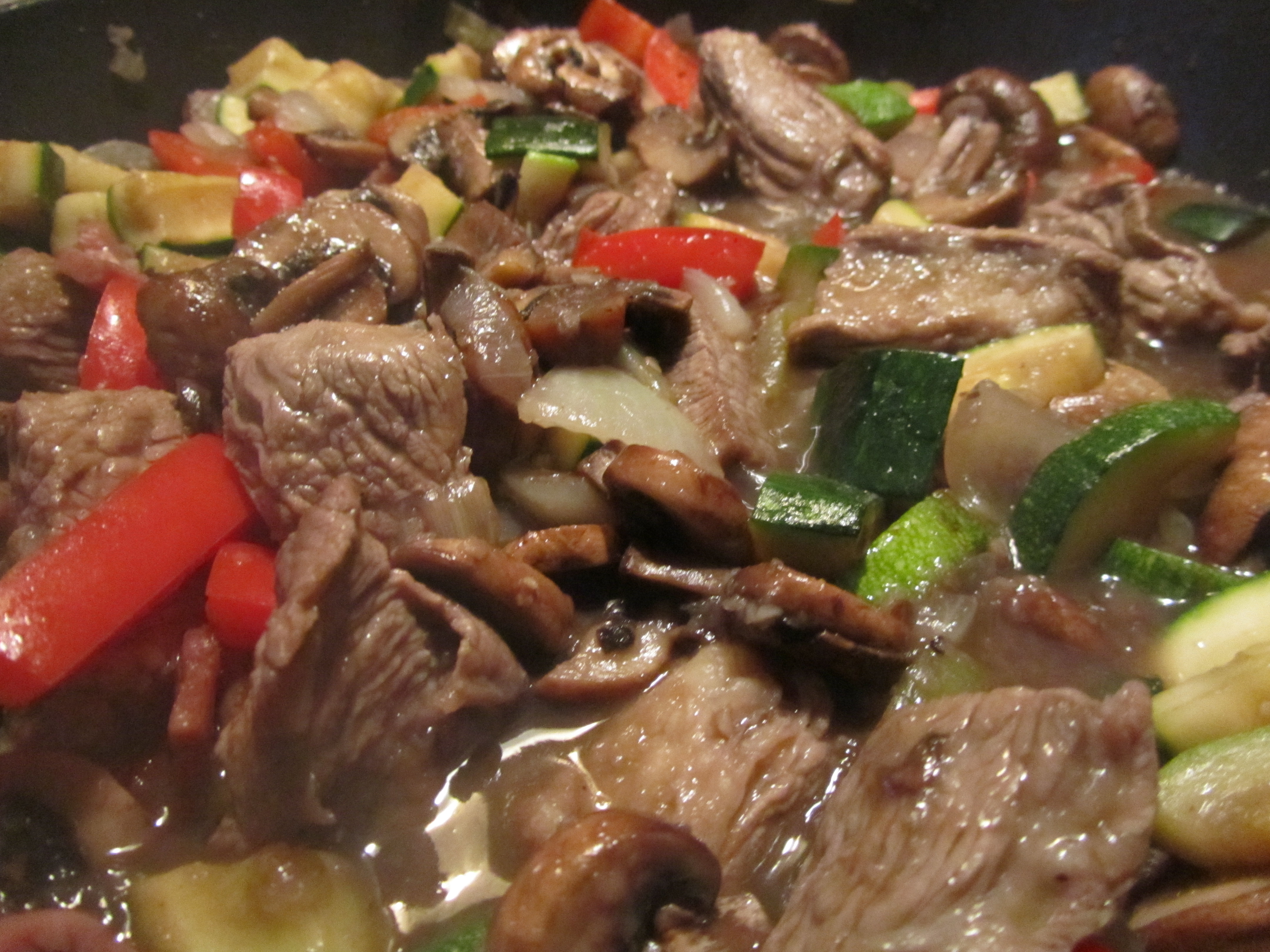
A dish with no history and minimal verbiage. I happened to have all these veggies in the fridge and Mr Caramelised brought home a cut of beef that screamed for stew. Forty-five minutes later, dinner was served.
Beef stew with mushrooms and vegetables
Ingredients
- 3-4 tablespoons of olive oil
- 2 yellow onions, cut in half-moon slices.
- 1 garlic clove, grounded
- 250g of button mushrooms (Agaricus bisporus), sliced
- 2 red peppers deseeded and sliced in fine strips
- 3 zucchini (=courgette) cut in slices
- 500g of stew beef cut in cubes
- 50g of flour or Maizena
- 100ml red wine
- salt and pepper
- 2 thyme springs
- 1 bay leaf
- 250ml of vegetable stock
Method
In a frying pan, heat 2 tablespoons of olive oil until it shimmer. Toss the mushrooms. Let them fry until soft and fragrant. Reserve.
Clean the frying pan with a kitchen paper, put more olive oil and heat it until it shimer. Put the red pepper in, and let it fry until soft. Finally, add the courgette in the pan, and let it fry for a few minutes until soft . Reserve courgette and red peppers, together with the mushrooms.
In the meanwhile, place beef cubes and flour in a bowl, season with salt and pepper and toss to coat. Shake off excess flour. Heat 2 tablespoons olive oil in a large frying pan over a high heat until it shimmer. Add half the floured meat and fry until sealed and meat has begun to brown. Be careful not too put too many pieces in the frying pan. Instead of frying, the meat will boil to death, with rather unpleasant results. Reserve the meat.
In the same frying pan, put the onion and fry until caramelised, stirring occasionally (it must be soft and translucent. It will take about 15minutes). Add the grounded garlic and the reserved flour and panfry, stirring, for 1 minute. Pour in approximately 100mL of red wine stir well to combine and deglaze the frying pan. When the sauce starts to thicken, toss in the meat and reserved vegetables. Mix well to combine, and then add the vegetable stock. Add the bay leave and the thyme.
Let simmer for about 15min, until the stock reduces to half and the sauce is a bit thick. Take out from the stove and let it rest for a bit.
Tomato soup
Posted: August 26, 2011 Filed under: Soup, Vegetables, Vegetarian | Tags: Herbs, Spices, Tomato Leave a comment
It seems today is the last day of Summer. Tomorrow, it will rain and the temperature will drop down; next thing we know, snow will be here and we will all be wearing fluffy thing around our ears. It might be my last chance to post this (cold) tomato soup.
I came across many different versions of tomato soups: my Mother’s (with potatoes), my nanny’s (with loads of potatoes, croutons and a poached egg), Maria de Lourdes Modesto‘s (with rice), the German way (with cabbage), the Swiss way (boil the tomatoes to death and then add an equal amount in volume of cream), the Austrian way (as before, plus pumpkin seed oil), the Spanish way (called gazpacho and eaten cold. In fact, God forbids it’s served warm) … And then, there is this one, the mean tomato soup Yotam Ottolenghi‘s Mother used to do. I took the liberty of replacing the coriander by manjericão (Ocimum basilicum), better known as Portuguese basil. Not food snobbery: I actually have it growing on a pot, courtesy of P. and D.
Tomato soup
Ingredients
- 2 tbsp olive oil, plus extra to finish
- 1 large onion, peeled and chopped
- 1 tsp cumin seeds
- 2 garlic cloves, crushed
- 750ml vegetable stock
- 4 large ripe tomatoes, chopped
- 400ml tin chopped Italian tomatoes
- 1 tbsp caster sugar
- 1 slice sourdough bread
- 2 tbsp chopped coriander, plus extra to finish (I used Portuguese basil)
- Salt and black pepper
Method
Heat the oil in a medium saucepan, add the onion and sauté, stirring often, for five minutes, until translucent. Add the cumin and garlic, and fry for two minutes, then add the stock, both fresh and tinned tomatoes, sugar, a teaspoon of salt and a good grind of black pepper. Bring to a gentle simmer and cook for 20 minutes, adding the bread halfway through. Add the coriander, then pulse-blitz the soup a few times to break down the tomatoes a bit – you want them a little coarse and chunky. (This soup should be quite thick, but add a little water to thin it down if you prefer.) Serve drizzled with oil and garnished with fresh coriander.
Sabih, tahini sauce, zhoug and salad
Posted: August 23, 2011 Filed under: Eggs, Salad, Vegetables, Vegetarian | Tags: Aubergine, bread, Eggs, Herbs, Salad, Spices, Tahini, Yotam Ottolenghi 1 Comment
An Israeli chef gives his interpretation of an Iraqi dish, topped with an Yemenite green chilli sauce. And, a pretty damn good it was, just ideal for this sort of weather…. The recipe was brought to the Guardian (here), by the hand of Yotam Ottonleghi. You know the drill: kilometric list of ingredients and several elements to put together at the end. But, it is worthwhile the effort – the combination of flavors and textures is delicate and at the same time exciting. Each one has its place and none is over-powering. It can be cooked in large batches and stored in the fridge to be eaten ad hoc.
Sabih, tahini sauce, zhoug and salad
Ingredients
For the sabih
- 2 large aubergines
- About 300ml sunflower oil
- 4 slices rustic white bread, toasted
- 4 free-range eggs, hard-boiled and cut into 1cm-thick slices
- Salt and black pepper
For the tahini sauce
- 100g tahini paste
- 80ml water
- 20ml lemon juice
- 1 small garlic clove, crushed
For the salad
- 2 ripe tomatoes, cut into 1cm dice
- 2 mini cucumbers, cut into 1cm dice
- 2 spring onions, thinly sliced
- 1½ tbsp chopped parsley
- 2 tsp lemon juice
- 1½ tbsp olive oil
For the zhoug
- For the zhoug
- 35g coriander
- 20g parsley
- 2 green chillies
- ½ tsp ground cumin
- ¼ tsp ground cardamom
- ⅛ tsp sugar
- ¼ tsp salt
- 2 garlic cloves, crushed
- 3 tbsp olive oil
- 2 tbsp water
Method
Using a vegetable peeler, peel off strips of aubergine skin from top to bottom, so they end up like a zebra, with alternating black-and-white stripes. Cut both aubergines widthways into 2.5cm-thick slices.
Heat the sunflower oil in a wide pan. Carefully – the oil spits – fry the aubergine in batches until nice and dark, turning once, for six to eight minutes; add oil if needed as you cook the batches. When done, the aubergine should be completely tender in the centre. Remove from the pan, leave to drain on kitchen paper, then sprinkle with salt.
To make the zhoug, put all the ingredients in a food processor and blitz to a smooth paste. For the tahini sauce, put the tahini paste, water, lemon juice, garlic and a pinch of salt in a bowl. Mix well, and add a little more water, if needed, so its consistency is slightly runnier than honey. Make the salad by mixing the tomato, cucumber, spring onion, parsley, lemon juice and olive oil. Add salt and pepper to taste.
To serve, place a slice of bread on each plate. Spoon a tablespoon of tahini sauce over each, then arrange overlapping slices of aubergine on top. Drizzle over some more tahini, without completely covering the aubergines. Season each egg slice, and lay on top of the aubergine. Drizzle more tahini on top and spoon over as much zhoug as you like – be careful, it’s hot! Serve the salad on the side; spoon a little on top of each sabih, too, if you like. Store any leftover zhoug in a sealed container in the fridge – it will keep for a week at least.
 Lucie Loves Food