Spaghetti and meatballs in a tomato sauce with basil
Posted: February 12, 2012 Filed under: Beef, Pasta, Pork | Tags: Carlos Horrillo and Patrick Morcas, David Leite, Herbs, minced meat, Pasta, Tomato 1 Comment
Comfort food for a bitterly cold day… For the this dish, I pulled recipes from 2 different books. The meatballs are a modified version of Carlos Horrillo and Patrick Morcas‘ take. The tomato sauce is the famous tomatada by David Leite I use ever so often.
Spaghetti and meatballs in a tomato sauce with basil
Ingredients for the meatballs
- 2 yellow onions, chopped
- 500g ground beef and pork
- 2 eggs, beaten
- 2 garlic cloves, minced
- 1 teaspoon dried oregano
- 1 teaspoon dried thyme
- 1 teaspoon dried rosemary
- 1 teaspoon dried persil
- 1 teaspoon dried parsley
- Salt and pepper freshly ground
- Olive oil to taste
- Flour as needed
Ingredients for the tomato sauce
- 3 tablespoons of olive oil
- 2 medium yellow onions cut in half lengthwise and sliced into thin half moons
- 2 springs fresh flat leaf parsley
- 1 bay leaf
- 2 garlic gloves minced
- 1 kg very ripped tomatoes, seeded and chopped* (or a couple of canned tomato, preferably san marzano, chopped, juices reserved).
- 2 to 3 tablespoons of double concentrated tomato paste, to taste
- 1 small fresh medium red hot chilli pepper, such as Serrano, stemmed, seeded and chopped (it optional. Sometimes, I just add a few drops of piri piri sauce).
- Freshly grounded salt and black pepper to taste.
- Fresh basil
- Spaghetti
- Boiling water
- Salt
- A little bit of olive oil
Method
Heat the stove the 190 oC (=375 oF).
Place a large heavy base, non stick frying pan on a low heat with 2 dashes of olive oil. Add the sliced onions, a pinch of salt and pepper then sauté gently until soft and tender. When it is done add the minced garlic and let it fry for a 1 minute more. Set aside to cool.
In a bowl combine the meat with the herbs, the eggs and the caramelised onion. Once the mix has aggregated, roll the meatballs with your hands. Roll them in flour so all the surface is coated.
Place a large heavy base, non stick frying pan on a low heat with 2 dashes of olive oil. Gently brown the meatballs, about 5min, adding more olive oil if needed. Reserve the frying pan.
Place the meatballs in a baking tray coated with olive oil and put it in the stove for about 30min or until they feel solid.
In the meanwhile, start the tomato sauce. Use the frying where you browned the meatball. Add more oil if necessary, and heat the oil until it shimmers. Add the onions, parsley and bay leaf and cook until nicely golden, about 15min. Add the garlic and cook for 1 min more.
Turn the heat to medium low, stir in the tomatoes and their juices, the tomato paste and chilli pepper, if using. Bring to a simmer, cook, lid ajar, stirring occasionally, until the tomatoes break down, about 30min.
Once the tomato sauce is done and the meatballs are out of the stove, you will need to combine both. Just drop gently the meatball in the frying pan, making sure the surfaces are coated. Let it simmer gently for about 20min.
In the meanwhile, boil spaghetti. Fill a large pot with water and bring it to a boil. If cooking dry spaghetti, use a mimimum of 500ml of water for each 100g. of dry spaghetti. Once the water is boiling, you will need to add the spaghetti. Reduce the heat so that the water is on a slow boil. Let it cook as said in the package. When ready, drain and add some olive oil to avoid sticking.
On a plate, put the spaghetti and on top the meatballs and the tomato sauce. Add a basil leaf for decoration and extra flavor.
Roasted chicken with sweet potato
Posted: February 5, 2012 Filed under: Chicken, Vegetables | Tags: Chicken, Honey, Leeks, Mafalda Pinto Leite, Sweet potato 3 Comments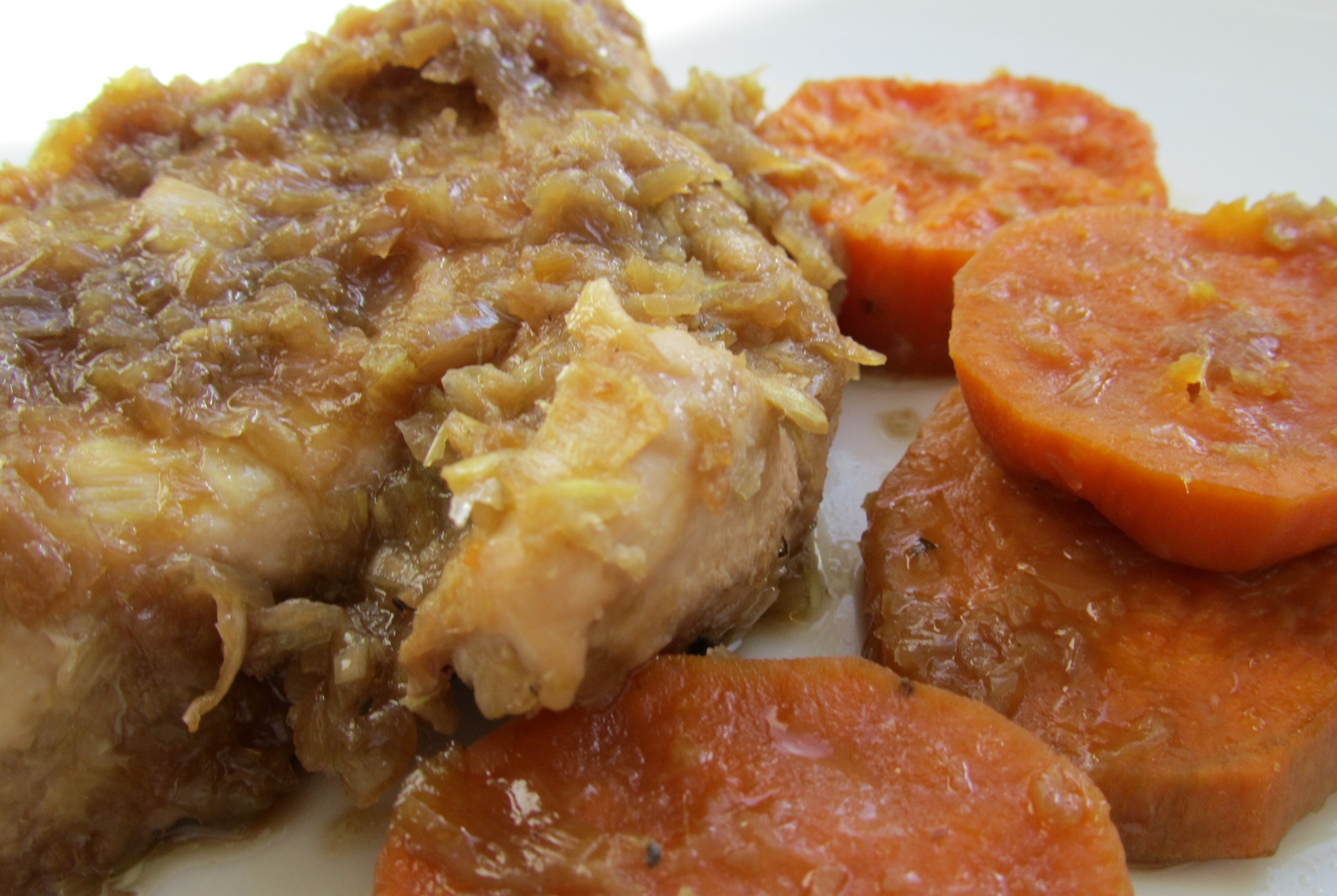
I had done dishes by Mafalda Pinto Leite before (here and here), and I knew she has good hand with combining different tastes and textures. Last time I was in Lisbon, I bought her book Cozinha Para Quem Não Tem Tempo [Cooking for those who have no time], to give it a try. Now that I have a regular office job again, it seemed like a good idea to have a bunch of recipes that are easy, quick and good all together. This was my first dish out of that book, and I have to say it seems I only got the last one right…. It is indeed an excellent combination of flavors and it warms your soul. However, it actually took way longer than she claimed and the recipe was a bit confusing. Nothing a good cook cannot fix, but nevertheless, a bit lame… Still worthwhile redoing and eating for as long as the Winter is here. Mind you, I ate it all and scrapped the Pyrex.
Roasted chicken with sweet potato
Ingredients
- 4 pieces of chicken (either breast or thighs)
- 2 garlic cloves
- 1 cup of chopped coriander
- 3 baby leeks, finely sliced (or 2 regular leeks, only white parts)
- 1 teaspoon of lemon zest
- 2 teaspoons of grated ginger
- 2 tablespoons of soy sauce
- 2 teaspoons of runny honey
- 1/3 water cup
- 200g sweet potato, peeled and sliced
- Olive oil to brush
Method
Pre-heat the oven griller to medium-high
Put the garlic, coriander, baby leeks, lemon zest, ginger, soy sauce, honey and water in a tall jug or beaker. Blend in with a mixer for about 2 minutes, until is chopped but still with pieces. Poor this sauce on top of the chicken and spread well. Reserve.
Brush the sweet potato with olive oil.
Put the chicken and the sweet potatoes on an oven proof dish and grill until it is golden and cooked.
You can serve this dish with a green salad.
Savoury tuna parcels (empanadillas de atún)
Posted: January 21, 2012 Filed under: Fish, Pastry and Baking | Tags: Carlos Horrillo and Patrick Morcas, Finger food, Pastry, Snack, Spain, Tomato, Tuna fish 3 Comments
Another Spanish classic… Very much like the tortilla de patatas [potato omelette], there are many versions and interpretations. And, as you might guess from previous posts, the best empanada is going to be the one cooked by the proverbial Mother-in-Law… Actually, at some point, I had scribbled down a recipe that had been in someone’s family for generations. But hélas!, I lost it during one of my many moves. I ended up to use the one Carlos Horrillo and Patrick Morcas have on their Tapas: Simple Flavours, Striking Combinations book.
All in all, it is not exactly easy to get this dish right. The filling is relatively straightforward, but the pastry requires a certain level of skill and commitment. Although this might sound like scratching a chalkboard with nails to some, I ended up using pre made pastry, to avoid any culinary catastrophes… In any case, it is an awesome combination of flavors and textures, which reminds me of home and many bohemian nights out.
Savory tuna parcels (empanadillas de atún)
For the filling
- Olive oil
- 2 medium onions finely sliced
- 1 large red pepper, finely chopped
- Salt and black pepper to taste
- 225g tomatoes coarsely chopped
- 350g of good quality tuna (in olive oil), drained
- 8-10 good quality black 0lives, stones removed
- Small pinch of saffron strands. soaked in 2 tablespoon hot water
For the pastry
- pack of ready rolled puff pastry
- 1 beaten egg
Method
Place a large heavy base, non stock frying pan (or wok) on a low heat with 8 dashes of olive oil. Add the sliced onions and pepper, a pinch of salt and pepper then sauté gently until soft and tender.
Add the chopped tomatoes and give everything a good stir, then simmer gently until all the ingredients have reduced to a thick sauce.
Add the tuna, olives, saffron and another pinch of salt and pepper, Summer everything together, stirring regularly until you have a tick, rich sauce. Set aside to cool, and then refrigerate for 2 hours.
Preheat your oven to 200oC/400oC/gas mark 6
Lightly flour your work surface and place the rolled puff pastry on top. Using a sharp knife, cut the pastry into 12cm squares and arrange them on several greased baking sheets. You will need 8-12, depending on how many people you are going to serve. Gauge it so you have enough pastry to wrap the filling. If the pastry is too thin the parcel will burst and all the ingredients will spill out. Some spillage is fine. If the pastry is too thick, it will not allow the flavours of the filling to come through.
Put a dollop of the tuna mixture, a ball shape roughly 5-6cm, in the middle of the square, and then dab the edges of the suare with eaten egg, Bring up the corners of the pastry to the centre and press them together to form a peak at the top. Glaze the tops with beaten egg, and then in the oven for 20min, or until golden brown. Serve hot, warm or cold.
Alternatively, you can put the pastry in the a rectangular or square baking tray, allowing the wall to be coated about 5cm. Put the tuna mixture on it, and put another sheet of pastry on top. Close the edges, sealling with beaten egg. Glaze the top with beaten egg.
Pear and almond tart, take 2
Posted: January 17, 2012 Filed under: Dessert, Pastry and Baking | Tags: Almond, Baking, Cake, Pastry, Pear, Sugar 2 Comments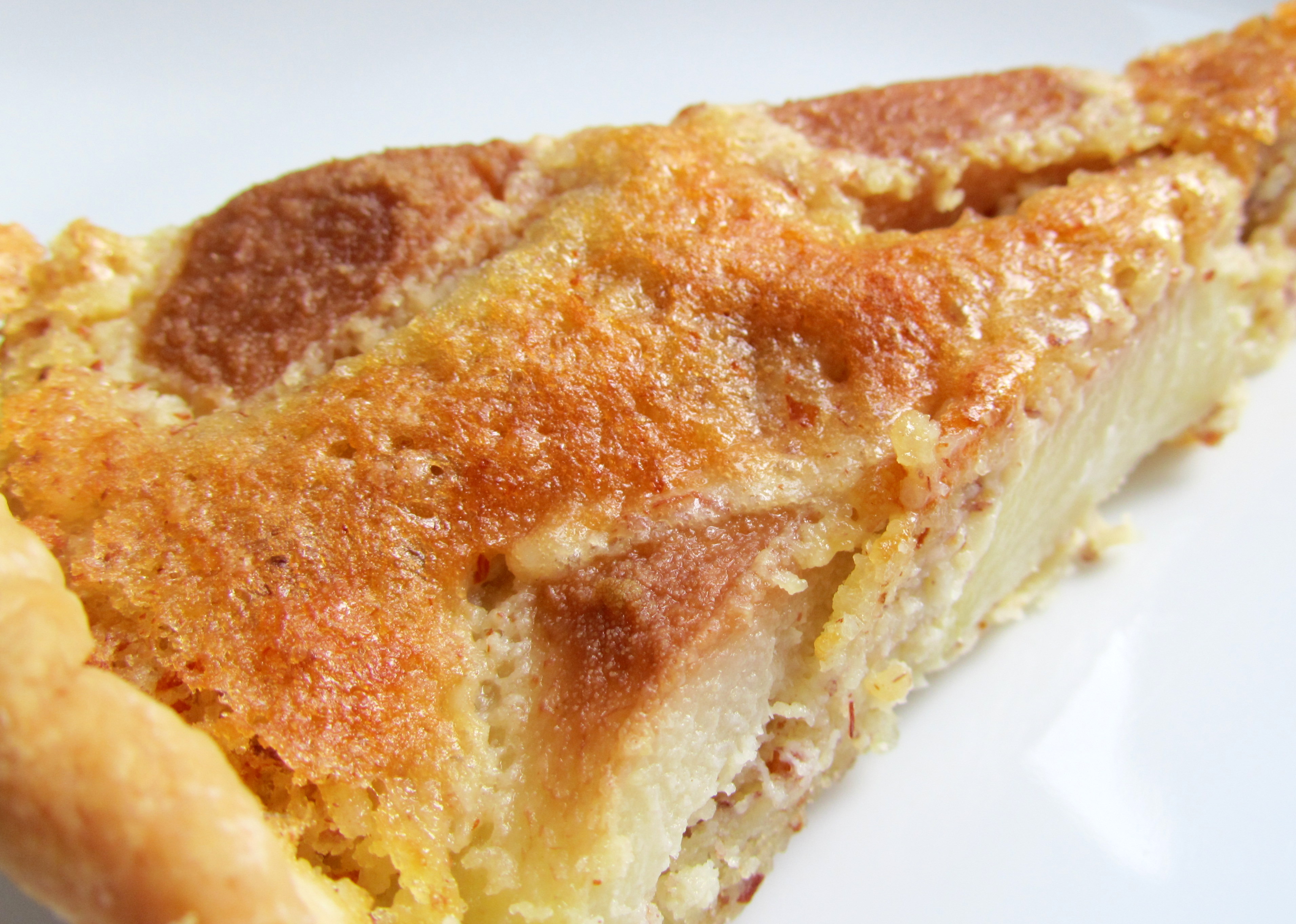
A Food&Travel dish I found on tram 11, back by popular demand. And, again, many happy testers….
As I was in a bit of a hurry, I used pre-made pastry.
Pear and almond tart
Ingredients
For the pastry
- 200g plain flour
- 2 table spoons caster sugar
- 100g cold unsalted butter cut into pieces
- a pinch of salt
For the almond cream
- 100g unsalted butter
- 100g sugar
- 2 eggs
- 100g ground almonds
- 2 table spoons flour
- 3-4 ripe pears
Method
To make the pastry, put the flour, sugar, butter and salt in a food processor, and, using the pulse button, process until the butter is broken down (about 5-10 pulses). Add 3 tablespoons of cold water, and pulse just until the dough forms coarse crumbs; add one more tablespoon of water if necessary, but do not do more than 10 pulses. Transfer the pastry to a sheet of backing parchment, form into a ball and flatten to a disk. Wrap in the paper and let stand for 30-60 minutes.
Roll out the pastry to the diameter of the baking tin (a tarte tatin or other round flame proof baking dish). Turn the tin upside down and on the rolled out pastry and press down and trace around the edge with a sharp knife.
Alternatively, just use pre made pastry. It might not be so good, but it does the trick.
Preheat the oven the 200oC. Prick the pastry all over, line with baking parchment, and fill with baking weights. Bake for 15min, then remove the paper and weights (I used beans), and bake for 10-15min more, until just golden. Let the tart shell cool slightly before filling.
To make the almond cream, put the butter and sugar in a bowl and mix with the electric mixer, until fluffy and lemon coloured (it takes some time and patience. I start with melted butter). Beat in the eggs one at a time. Using a spatula, fold in the almonds and flour until well mixed.
Preheat the oven to 190oC. Spread the almond cream evenly in the tart shell. Peel and core the pears, and slice into 8-12 pieces, depending on the size of the fruit. Arrange the pear slices on top of the almond cream. Bake for about 20-30min, until puff and golden. Serve warm.
Fragrant orange slices
Posted: January 11, 2012 Filed under: Dessert, Fruit, Vegetarian | Tags: Gordon Ramsay, Honey, Orange, Pistachios Leave a comment
At some point over Christmas, I just felt the need to have something sweet but at the same time fresh and light. Meaning, a dessert that didn’t involve deep fried dough or extra sugary milk and eggs concoctions, all covered with even more sugar and a generous amount of cinnamon. While it was not sugar or cinnamon free, these fragrant orange slice were very nice break from all those Christmas excesses. And, for extra bonus, they provided the recommended daily dose of Vitamin C. Overall, it is super easy dish to do, and is ideal to finish a decadent rich meal. Original recipe was found in Gordon Ramsay’s Fast Food.
Fragrant orange slices
Ingredients
- 4 large oranges
- 1 1/2 tablespoon runny honey
- 1 tablespoon orange blossom water
- pinch of ground cinnamon
- 50g toasted walmuts for pistachios, roughly chopped.
Method
Slice off the top and bottom of each orange and place upright on a chopping board. Following the curve of the fruit, cut off the skin, making sure that you remove the withe pith as well. Turn the peeled orange on one side and cut into slices, removing any pips as you do so.
Arrange the orange slices overlapping on individual plates. Mix the honey with the orange blossom water until evenly blended, then drizzle over the orange slices. Mix the cinnamon and chopped walnuts together and scatter over the oranges to serve.
Polenta and parmesan gratin
Posted: January 6, 2012 Filed under: Pulses and lentils, Vegetarian | Tags: Cheese, Ferran Adria, Polenta 1 Comment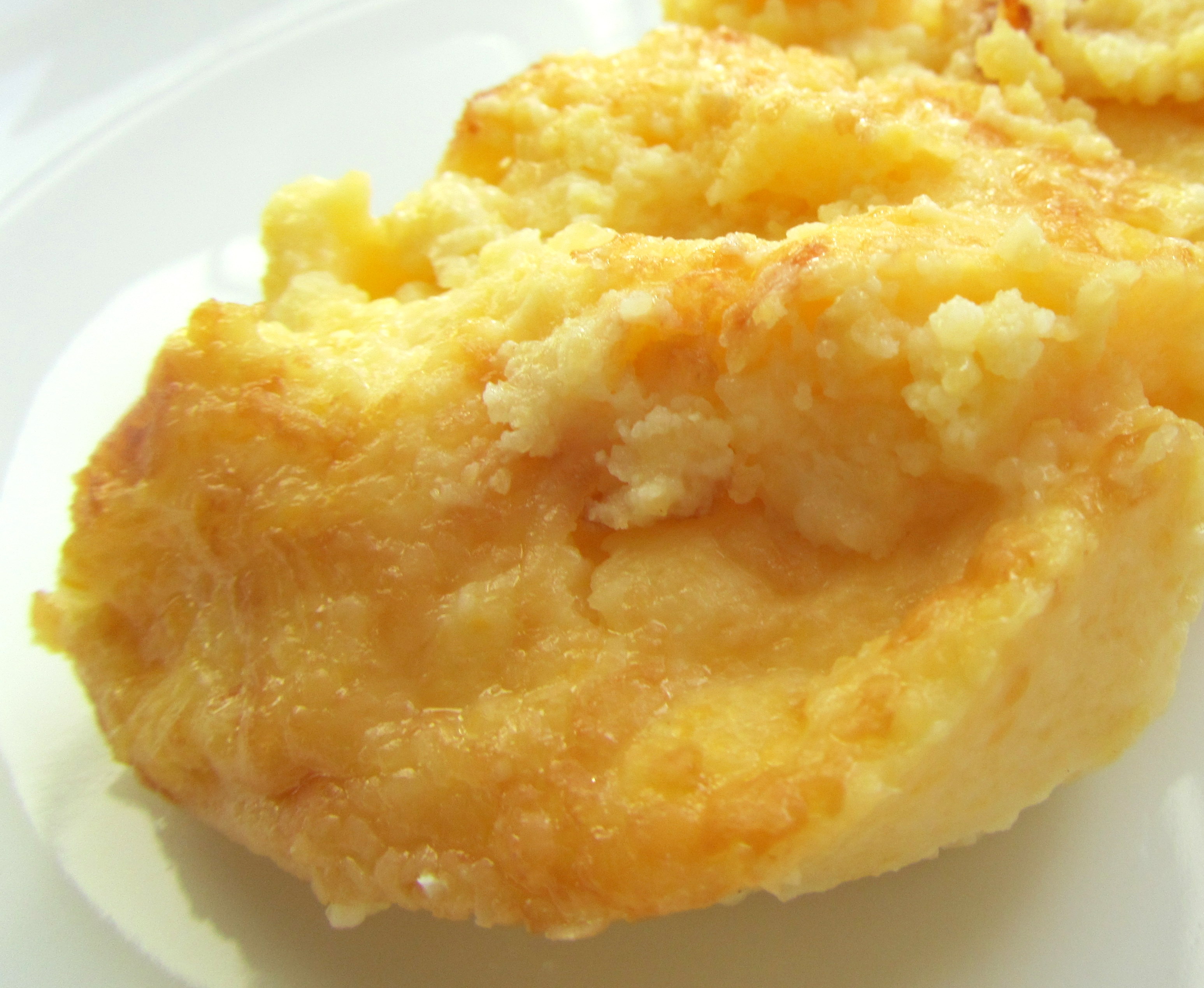
…and this is the polenta I did to go with with the pork loin with roasted peppers and garlic & parsley olive oil. Also a Ferran Adrià’s The Family Meal dish, it is über-delicious and creamy. Probably the best polenta I ever had. For sure, I will do it again. M. even suggest it might go well with Portuguese style codfish.
Polenta and parmesan gratin
Ingredients (for 6)
- 900ml water
- 150g polenta (quick cook variety, which will take about 5-10min to get ready)
- 300ml whipping cream
- 2 teaspoon butter
- 120g Parmesan cheese finely grated
- 4 tablespoon Parmesan for the gratin
Method
Pre-heat the grill to high (top shelf of stove, about 180oC)
Poor the water into a saucepan and bring to boil. Sprinkle in the polenta a little at the time, whisking continuously.
When all the polenta has been added, cook for 2 minutes over a medium heat, whisking continuously.
Pour in the cream and cook for another 2 minutes.
Gradually add the first quantity of Parmesan cheese and add the butter.
Keep whisking until the polenta has thickened. Season with salt.
Poor the polenta into a large backing tray or heatproof dish. The polenta should be about 1 cm deep.
Leave the polenta to stand 5 minutes and then sprinkle with the second quantity of grated Parmesan.
Put in the stove and grill until the cheese is golden and bubbling.
Serve immediately.
Pork loin with roasted peppers and garlic & parsley olive oil
Posted: January 2, 2012 Filed under: Pork, Vegetables | Tags: Ferran Adria, Garlic, Olive oil, Pork, Red pepper 1 Comment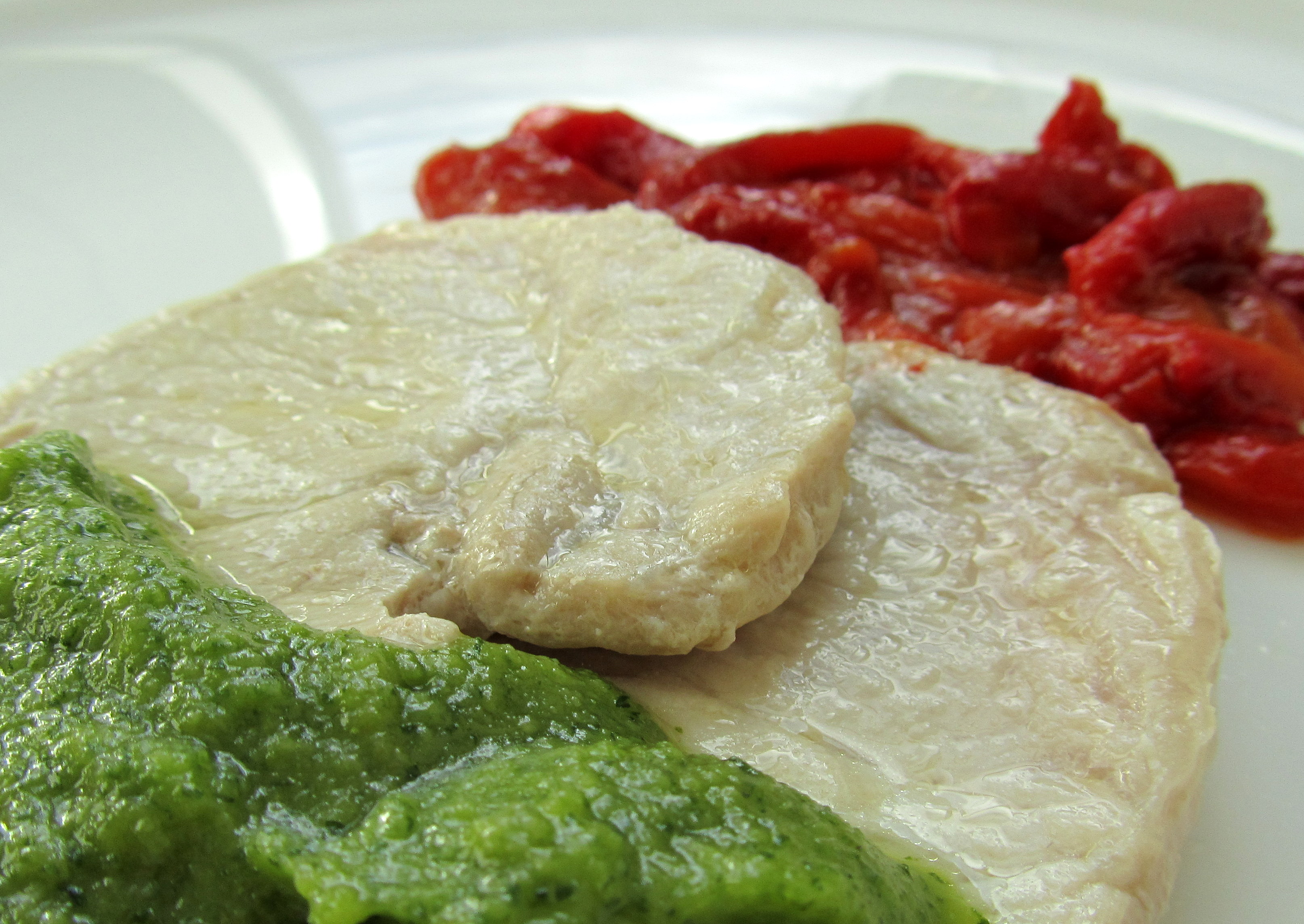
Of course I had to get Ferran Adrià‘s The Family Meal. How could I not, specially if Ferran Adrià promises dishes any cook can do, at an affordable price of €5 per person? And, this is the first dish I did. While I am very proud I could pull an Adrià dish all by myself, I also have to say it was not horribly complicated. It could even be a weekday meal…. The dish itself s great – the sweetness of the red pepper combines to perfection with the pork. The parsley and garlic olive oil is fresh and has a delicate flavour. All in all, a delicious no-too-much-fuss.
Pork loin with roasted peppers and garlic & parsley olive oil
Ingredients (for 6)
- 2 large red peppers
- 100mL olive oil, plus extra for frying
- 6 garlic cloves (peeled)
- 3 springs fresh parsley
- 18 thin cut pork loin steaks
Method
Preheat the oven to 200°C/400°F/Gas mark 6. Rinse the peppers, and then place in a roasting tin while still slightly wet.
Drizzle with a little olive oil and roast for 45min
Fill a small saucepan with water then add the garlic. Bring the pan to boil.
Lift the garlic out of the water and into a bowl of iced water to quickly cool. Repeat this twice, starting with cold water in the saucepan each time
After 45min, the peppers will be blackened and soft. Leave until cool enough to handle. Keep any juices that have collected in the pan.
Peel the skin from the peppers and remove the seeds. Do this over a bowl to catch any juices.
Cut the pepper flesh into thin strips. Put the peppers and the reserved juices into a pan and simmer over a low heat for 5min.
Pick the leaves from the parsley leaves from its stems.
Put the drained, blached garlic, parsley leaves and remaining oil into a tall jug or beaker. Process with a hand held blender until finely chopped.
Place a large frying pan over a high heat and add a little olive oil. Fry the pork for 1 1/2 min until golden on both sides and juicy in the middle.
Season the pork with salt and pepper, and serve with the peppers. Finish with a tablespoon of garlic and parsley oil.
Vanilla buttercream frosting cake
Posted: December 20, 2011 Filed under: Dessert, Vegetarian | Tags: Cake, Dessert, Sugar, Vanilla 1 Comment
You have read it correctly – there are no typos in this sentence nor it is poorly constructed. While the vast majority of cakes have frosting on top or in the middle, the batter of this sponge cake was indeed made using a vanilla buttercream frosting. If there is an Annals of Improbable Culinary Research in this world, this dish would be worthwhile a cover. Or, at least a featured article. In fact, the vanilla buttercream frosting cake is so unlikely to be reproduced, that I will not even try to write down the recipe. If anything, because I cannot remember what ingredient was used when, or the proportions.
Even wannabe-food-bloggers have a less-inspired days in the kitchen. Sometimes, things just don’t go the way you expect – and as we say in Portugal, o que torto nasce, tarde ou nunca se endireita [what is born crooked, late or never gets straightened]. It looked like an semi-easy cake when I read the recipe. But a few hours latter, with the cake still half done and a totaled kitchen, it seemed that I had made a colossal strategic mistake.
Everything went sort of OK, until I tried to whisk the egg whites to soft glossy peaks. I must have done this thousands of times and at this point in my life, I don’t even consider the possibility of failure. But, not today. The white egg mix split, and there was nothing I could do about it. They were split and they remained split, no matter what grandmother tricks I used. I had no other solution but start all over again.
When I thought the worst was over and the cake was placidly sitting on the stove, I started on the frosting, using a Nigella recipe. Instead of a consistent white cream I was supposed to get, I ended up with a grey-greenish liquidy crème with lots of white floaters. I tried to sieve it, as recommended by most Mothers and professional chefs. After this delicate operation, the floaters were gone, but the grey-greenish liquidy could not be used to finish any serious cake. Again, had to start again, this time using the recipe of the original recipe. It called for a lot of butter and even more sugar, but .. it worked. I have to bitterly add, that Nigella’s recipe failed me not once, but twice.
At this point, I had my kitchen bench full of discarded elements: the gray-greenish liquid (basically, butter, sugar, vanilla and some flour), 3 yolks and something that resembled beaten white eggs. Meaning, the elements you need for a cake. Following tje directions of a very basic recipe of sponge cake, I added the egg yolks one by one to the butter and sugar “cream”. Then I tossed in enough flour – and 1 teaspoon of baking powder – to obtain a batter with a nice consistency. Finally, I folded in the egg whites. No need for a lot of TLC- it was actually quite the opposite of this.
Finally, I dropped into the stove, previously heated to 175oC (pretty much a standard of baking), and waited until a wooden stick came out dry from the center of the cake.
The result was a surprisingly light sponge cake, with a fresh almondy – vanilla taste. None of the testers was aware of the precarious conditions of this experiment, and fortunately they are all still alive. Some of them even asked for seconds (and got them).
Mandarin orange coconut cake
Posted: December 15, 2011 Filed under: Dessert, Pastry and Baking | Tags: Baking, Cake, Coconut, Food blogger recipe, Mandarin orange, Sugar Leave a comment
For obscure reasons I was not able to find out, in Switzerland tradition include giving bags of mandarin oranges, peanuts and a few chocolates. The kind of thing you might get at office or from a distant relative…. I was looking for a Christmassy dish, when I saw this on Cinco Quartos de Laranja who had seen it on All Recipes and then tweaked it a bit. By a happy coincidence, I actually had way too many mandarin oranges on the fruit bowl, a tiny bit of coconut in my cupboard and just enough time to bake it. And, voila!, a Christmassy and at the same time fresh and casual dish. Actually, it is also delicious and light, with different flavors and textures in each bite. An excellent way of fooling kiddies into eating their daily dose of citrus.
Mandarin orange coconut cake
Ingredients
- 200g flour and 1 spoon of baking powder, sifted
- 175g sugar
- 170g unsalted butter
- 150mL of mandarin orange juice
- The zest of 3-4 mandarin oranges
- 30g dry powdered coconut
Method
Preheat the oven to 180C. Coat a baking tray with baking spray (or butter and flour)
in a large bowl, beat the butter and the sugar until light and pale yellow.
Add the egg one at a time, beating for 1 minute after each addition.
Fold in the flour and mix well. Once it is well mixed, add the coconut, the mandarin orange juice and zest. Mix until the mixture is uniform.
Put the cake tin in the preheated oven. Bake the cake until golden brown and a toothpick inserted in the middle comes out clean (about 30min)
Pumpkin Soup with Chicken and Ginger-Braised Leeks
Posted: December 7, 2011 Filed under: Chicken, Soup, Vegetables | Tags: Autumn, Charlie Trotter, Chicken, Ginger, Leeks, Pumpkin, Soup Leave a comment
This is not an easy to make soup. But, it is totally worth the effort… It might even be the best pumpkin soup I have had, with the obvious exception of Mrs Caramelized Sr’s creations. Just bumped into the recipe almost by accident on David Leite‘s website. By coincidence, I had all the main ingredients, a lot of time in my hands and the inclement weather was unsuitable for any attempt to try anything outdoors.
Half way through the making of the soup, while struggling with so many elements and details, I took a closer look to the post header. It turned out this dish is authored by Charlie Trotter, better know for its stylish and imaginative cuisine (meaning – a bit too difficult for the rest of us mortals). I probably would have never had the guts to try it if I had realized this earlier. But, once you start doing it, what else can you do but carry on and finish the dish?
A couple of tweaks were made though. The original recipe calls for thyme to be added to the pumpkin roast, and sage to finish the dish. I had none, either dry or alive, and simply omitted it. Also, instead of chicken breasts I had chicken thighs. Ended up doing the same that Yotam Ottholengi does for its chicken and buttermilk cold soup.
Pumpkin Soup with Chicken and Ginger-Braised Leeks
Ingredients
For the preserved ginger
- 6 tablespoons peeled and julienned fresh ginger
- 1 1/2 cups (=300g) sugar
- 1 1/2 cups (=375mL water)
For the soup
- 1 small pumpkin, halved and seeded (I picked already cut pumkin, about 1,5kg)
- Salt and freshly ground black pepper
- 3 tablespoons extra-virgin olive oil, plus extra for drizzling
- 4 chicken thighs
- 1 yellow onion
- 1 garlic clove
- 4 cups (=mL water) chicken stock, or enough to cover the chicken thighs
- 2 leeks (white part only), cut into 1 cm inch-thick slices
- 5 tablespoons (=70g) unsalted butter
- 3 cups (= 375mL water) chicken stock (or enough to cover the chicken thighs)
- 1 tablespoon plus 1/4 cup preserved ginger
- 4 chicken thighs
Place the ginger, 1/2 cup (=100g) of the sugar, and 1/2 (=125mL) cup of the water in a small saucepan. Simmer for 10 minutes, strain the liquid, and repeat the process two more times, reserving the final cooking liquid to store the ginger. Use immediately, or refrigerate for up to 1 week.
Make the soup
Preheat the oven to 350°F (=175°C). Season the flesh of the pumpkin with salt and pepper and rub with the olive oil. Place the pumpkin pieces on a baking sheet. Add enough water to have about 1cm water in the oven dish 45 to 60 minutes, or until tender.[the recipe called for thyme sprigs to be put under the pumpkin, but I had none at home.]
In the meanwhile, start the kitchen broth. Heat two tablespoons of oil in a large saucepan and sauté the onion and garlic on a low heat for five to 10 minutes, until soft but not coloured. Add the chicken, and the salt and the pepper to taste. Pour in stock just to cover and simmer gently for 30 minutes, until the chicken is cooked. Reserve the broth and shred the chicken off the bones while it is hot . I always discard the skin, but that is entirely up to your taste.
Cook the leeks with 2 tablespoons (= 30g) of the butter in a saucepan over medium heat for 10 minutes, or until translucent. Add 1 cup of the stock and the 1 tablespoon ginger and cook over medium-low heat for 25 minutes, or until the leeks are soft and most of the liquid has been absorbed. Keep warm.
Puree the 1/4 cup ginger and any residual ginger juice, the chicken broth, and the pumpkin pulp until smooth. Season with salt and pepper. Cook the soup in a saucepan over medium heat for 5 minutes, or until warm. Whisk in the remaining 3 tablespoons (=40g) butter and season with salt and pepper.
Spoon some of the leeks into the center of each bowl and ladle the soup around the leeks. Arrange some of the shredded chicken in the center of each bowl. Drizzle with olive oil and serve immediately. [the recipe called for sage leaves to be added, but I had none at home.]
 Lucie Loves Food