Piedra Lagar 2008
Posted: January 3, 2011 Filed under: Wine | Tags: Spain, Wine Leave a comment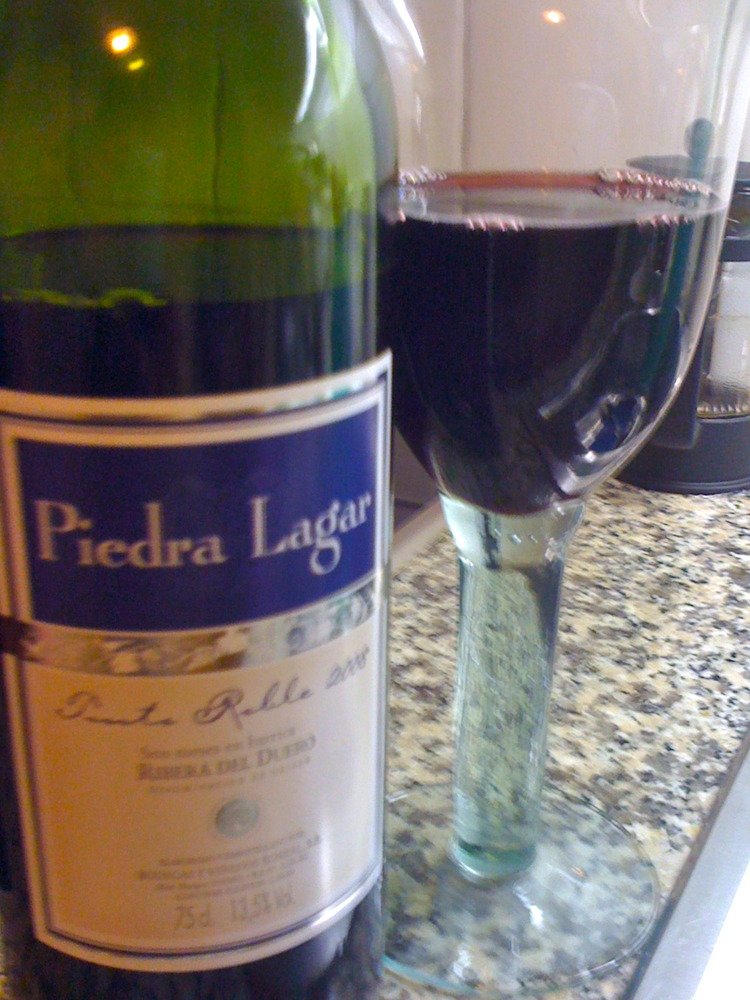
A lovely Ribeira del Duero: Piedra Lagar Tinto Roble 2008. It was highly recommended by the owner of Ugarte, a small Spanish wine shop in Zurich. It was just one this wines that has different flavors as you taste it, from fruity to peppery.
Weingut Isegrim Hof
Posted: December 21, 2010 Filed under: Wine | Tags: Eating and drinking out, Wine Leave a comment
Afternoon shopping at the Viadukt delicatessen market. “Do you want to have a wine? Come on, the last one…”, M. asks. And off we go to Braschler’s Comestibles, the only fishmonger in Zurich that actually smells like a proper fishmonger. Not only only they have fish and seafood worthwhile to mortgage the house to buy – they also carry this sweet flowerly Riesling wine. As its own name says, it was good. Very good.
Roasted sweet potatoes pan fried with roasted red onions, pine nuts and feta cheese
Posted: December 18, 2010 Filed under: Vegetables, Vegetarian | Tags: Carlos Horrillo and Patrick Morcas, Feta cheese, Pine nuts, Red onions, Roast, Sweet potato 2 Comments
I have already mentioned it a few times: Tapas – Simple Flavours, Striking Combinations, by Carlos Horrillo and Patrick Morcas, is one of my favorite cookbooks. And, the roasted sweet potatoes is one of my favorite dishes. It looks a bit laborious, but most of the roasting can be done in advance.
Roasted sweet potatoes pan fried with roasted red onions, pine nuts and feta cheese
Ingredients
- 3 large sweet potatoes cut in 3 cm slices
- garlic infused oil (I normally out 4 crushed cloves in 100ml olive oil and let it rest for a while)
- salt and pepper
- 3 red onions cut into quarters
- 1 heaped tablespoon of pine nuts
- 75g of feta cheese
Method
The stove goes at 200oC (mark 6).
Put the sweet potatoes in roasting tray and drizzle generously with garlic oil until they are well coated. 2 pinches of salt and 3 pinches of pepper and then mix well. Put in the middle of the stove for about 1h, and mix every now and again to ensure they don’t burn.
Put the onion quarters in a small roasting tray and drizzle with garlic oil. Season with salt and pepper. Place them at the bottom of the stove and cook for 20min.
For the pine nuts, get a small frying pan and put it at low heat. Do not add oil. Drop in the pine nuts and fry gently stirring constantly until they are golden brown. Reserve.
When the onions and sweet potatoes are ready, place a large heavy based non sticky frying pan on a medium to high heat and put enough garlic oil to cover the bottom Drop in half the roasted sweet potatoes and fry until they start to break. Add half the roasted onions and give everything a good stir. Cook for 5min, stirring the whole time to avoid burning. Take it out from the pan and keep it hot. Repeat with the remaining roasted potatoes and onions.
When the second batch is almost ready, add the first batch to the pan and reduce the heat to low. Carefully stir in the feta cheese and the pine nuts and continue cooking until the feta is almost melting. Serve straight away.
Chocolate creations by Wild & Edel
Posted: December 13, 2010 Filed under: Chocolate | Tags: Chocolate Leave a comment
A happy finding at the Viadukt: The chocolate creations by Wild&Edel. Gabriela, the owner, uses wild plants to create truly delicious fresh chocolate delicatessen. In the picture: dark chocolate with mint scales, green hazelnuts with white and dark chocolate, truffles with cream, lavender and poppy seeds, and truffles with elderberries and hazelnuts.
Pan fried chorizo with roasted peppers and Fundador Brandy
Posted: December 8, 2010 Filed under: Sausages | Tags: Carlos Horrillo and Patrick Morcas, chorizo, Red pepper, Spain Leave a comment
Another recipe from one of my favorite cook books: Tapas: Simple Flavours, Striking Combinations by Carlos Horrillo and Patrick Morcas. You can use any brandy, really, but only Fundador Brandy gives it a special flavor. Needless to mention some caution is needed while flambée-ing.
Pan fried chorizo with roasted peppers and Fundador Brandy
Ingredients
- 2 medium red peppers
- Olive oil
- Garlic infused oil (just mix garlic to taste with olive oil, mix and let rest for a few hours).
- 8 spice chorizo sausages (if you want to be very precise, you should look for Rosario chorizos), cut into 2cm slices
- 50ml Fundador Brandy
- parsley, roughly chopped
Method
Spike the 2 peppers with skewers and hold them over a high flame on the stove until the skin is charred and black. Leave the peppers to cool down a bit, then peel of the skins and hull them (for practical reasons, I never do this. Probably, I get a more rustic dish).
Place 2 dashes of olive oil in a heavy based frying pan and put on at medium heat. Add the skinned peppers and sear them quickly all over. Remove them all over and put them in a dish. Sprinkle over some garlic infused olive oil and salt, allow them cool and then cover the dish with clingfilm and leave to marinate in the fridge for a couple of hours.Once done, cut the peppers into slices and leave to one side.
Place a clean large heavy-based frying pan (or wok) on a high heat. Add 2 dashes of olive oil and tilt the pan backwards and forwards to coat the base completely. When to oil is smoking hot, drop in the sausages and cook fiercely until they start to brown and release their fat. At this point put the sliced marinated peppers and cook for 20 seconds more. If you are cooking on gas, be careful. The fat will spit and might ignite. Put in the Brandy – it is very likely that the pan will ignite. If not, just use a match to start the flambee. Let it cook for 10 seconds, or until the flame is gone. Then toss in the parsley. Serve right away.
The ultimate Winter couscous
Posted: November 30, 2010 Filed under: Grains, Pulses and lentils, Vegetables, Vegetarian | Tags: Apricots, Carrots, Chickpeas, Couscous, Parsnips, Pumpkin, Roast, Spices, Yotam Ottolenghi Leave a comment
Frei Grande 2008
Posted: November 29, 2010 Filed under: Wine | Tags: Portugal, Wine Leave a comment
I got this bottle of Frei Gigante in Lisbon shop specialized in Azores’ delicacies. It is definitely a girly wine: fruit, fresh and light. The kind of number that goes up to your head and makes you giggle in less time than finishing the first glass.
Long story for a delicious bottle of wine, thoroughly enjoyed with some friends. It was produced in the Island of Pico, in the Archipelago of the Azores. The inhabitants of the Island had to build walls with stacked basalt rocks to protect the vineyards from the strong Atlantic winder and sea water. The grapes that grown amongst this network of rocky cubicles have to be hand picked. Verdelho, arinto and terrentez are the only grapes permitted to grow in the Island of Pico. Needless is to say, that the production volume is quite small. Most of the wine stays in the Pico Island and only a few bottles make their way to the Continental Portugal. And this one, did an extra flight to get to Zurich.
Pear and almond tart
Posted: October 24, 2010 Filed under: Dessert, Pastry and Baking | Tags: Almonds, Cake, Dessert, Pears, Sugar 1 Comment
I found this pear and almond tart recipe on my way home, on tram 11. Someone left behind a Food & Travel magazine behind, and curiosity made me pick it up to flip through. Two tram stops latter, I had already decided to try all recipes. As pears are at its prime around A.’s birthday, it has become her official birthday cake. Well, sort of.
Pear and almond tart
Ingredients
For the pastry
- 200g plain flour
- 2 table spoons caster sugar
- 100g cold unsalted butter cut into pieces
- a pinch of salt
- 100g unsalted butter
- 100g sugar
- 2 eggs
- 100g ground almonds
- 2 table spoons flour
- 3-4 ripe pears
To make the pastry, put the flour, sugar, butter and salt in a food processor, and, using the pulse button, process until the butter is broken down (about 5-10 pulses). Add 3 tablespoons of cold water, and pulse just until the dough forms coarse crumbs; add one more tablespoon of water if necessary, but do not do more than 10 pulses. Transfer the pastry to a sheet of backing parchment, form into a ball and flatten to a disk. Wrap in the paper and let stand for 30-60 minutes.
Roll out the pastry to the diameter of the baking tin (a tarte tatin or other round flame proof baking dish). Turn the tin upside down and on the rolled out pastry and press down and trace around the edge with a sharp knife.
Alternatively, just use pre made pastry. It might not be so good, but it does the trick.
Preheat the oven the 200oC. Prick the pastry all over, line with baking parchment, and fill with baking weights. Bake for 15min, then remove the paper and weights (I used beans), and bake for 10-15min more, until just golden. Let the tart shell cool slightly before filling.
To make the almond cream, put the butter and sugar in a bowl and mix with the electric mixer, until fluffy and lemon coloured (it takes some time and patience. I start with melted butter). Beat in the eggs one at a time. Using a spatula, fold in the almonds and flour until well mixed.
Preheat the oven to 190oC. Spread the almond cream evenly in the tart shell. Peel and core the pears, and slice into 8-12 pieces, depending on the size of the fruit. Arrange the pear slices on top of the almond cream. Bake for about 20-30min, until puff and golden. Serve warm.
Ojo de Agua (2007)
Posted: October 16, 2010 Filed under: Wine | Tags: Wine Leave a comment
A well enjoyed bottle of Argentinean wine: Ojo de Agua Malbec. A heavy and dense one, but just what we needed for the Sunday roast chez A. & S.
Tortilla de patata [Spanish omelette]
Posted: September 28, 2010 Filed under: Eggs, Vegetarian | Tags: Carlos Horrillo and Patrick Morcas, Omelette, Potatoes, Spain 1 Comment
No matter how much effort, love and care you put into it, someone mother’s tortilla will be always better than yours. And don’t even mention the supreme interpretation of this Spanish classic done by all Mothers-in-Law – specially yours. To stay away from trouble, I use the recipe I found in the book: Tapas: Simple Flavours, Striking Combinations by Carlos Horrillo and Patrick Morcas, and call it potato and caramelized onion omelette.
Tortilla de patata [Spanish omelette]
Ingredients
- 1.5 Kg Desiree red potatoes (I use 1Kg of parboiled roesti potatoes. Most Spanish Mothers and Mothers-in-Law would be horrified if they knew).
- Olive oil
- 1 large Spanish onion (always a controversial topic. For some, a proper tortilla de patata has nothing but eggs and potatoes; others would call the thought an heresy).
- knob of butter
- 10 eggs (no typo: it is indeed ten eggs you are going to need).
- Salt and pepper
Method
Peel the potatoes, cut them in half, and then cut each half into slices 1.5cm thick. Place in a pan of cold, salter water ad bring the to the boil. Parboil, or until just tender enough to pierce with a knife. Drain and leave to one side.
In a large, non-stick frying pan, around 30cm in diameter (preferably with slopping side because it will make turning the tortilla easier later on), place 12 dashes of olive oil and put on a low to medium heat (this is liberal quantity of olive oil – enough to cover the bottom of the pan with a thick film). Toss in the sliced onions and a generous pinch of salt and pepper, and start to fry them. Once the onions start to sizzle, turn the heat down to low and add the knob of butter. Cook the onions until they are soft and golden, and then remove them with a slotted spoon and place to one side.
Return the pan to medium heat, and add the par-boiled potatoes, a generous pinch of salt and a small pinch of pepper. Fry gently for 2 minutes, turning frequently or until the potatoes are lightly crisp and and golden on the outside while soft on the inside. Just before they are done, return the onions to the pan, stir them well and cook them together for about a minute. When done, remove everything with a slotted spoon and place in a bowl to one side. You will need the oil that was left at the pan for later.
Crack the eggs into a large bowl, add 2 generous pinch of salt, a small pinch of pepper and beat lightly together. Add the cooked potato and onion mixture and still well. Leave to stand for a few minutes, to allow the ingredients to marry.
Return the pan to medium to high head, add 6 more dashes of olive oil (again, until you have a thick oil film that covers the surface of the pan. Tilt the pan until the bottom is well coated. Do not forget to do is, or else you have parts of the tortilla firmly sticked to the bottom of the pan. Not a nice tortilla technique…). Heat the oil until smoking hot, then poor in the egg mixture, moving the pan in a gentle, circular motion to distribute the ingredients evenly and prevent the eggs to stick and burn. Cook for about 30 seconds, then turn down the heat to medium low, and cook for further 4 minutes, shacking the pan gently every so often. Do not stir! (Seriously, do not! If you stir, it will be a completely different dish). When the tortilla start to bubble on the side, it is time to turn over. If this the first time at doing this, prepare for a mess (let’s face the facts – it will get messy. It took a few times before Mr Burntsugar got the hang of it, but now he is an expert. I am more on the supervision and management side of things).
Find a suitable plate, large enough to cover the face of the pan with space to spare, and sit it face down on top. Hold firmly onto the handle of the pan with one hand and use the other hand to press down firmly the plate. Now, in one fast move, lift the pan of the stove and flip it over onto the plate. Remove the pan (hopefully, there’ll be little, if anything, left stuck to the base, and not a horrible mess to clean in the kitchen). Clean thoroughly the pan with kitchen paper roll. It is very important the bottom of the pan has no egg leftovers and burnt egg stick to it. Set down the pan while you add 12 more dashed of olive oil and tilt the pan to make sure the bottom is coated with a thick film of olive oil. When the oil is smoking hot, carefully slide the half cooked tortilla into the pan to cook on the other side. You might need to shake the pan gently and tuck in the sides of the tortilla with a wooden spatula because they will probably look a bit jagged. Allow the tortilla to cook in hight heat for about 30 seconds, then reduce the heat to medium low heat and cook for further 4 minutes. This should leave you with a tortilla moist in the middle (when the tortilla is this cooked to its point is another heated controversy). If you are the ones who prefer it firmer, cook it for a few minutes more, preferably before carbonization. When the tortilla is cooked to your taste, slide it onto a clean plate to cool down slightly. Serve it warm, at room temperature, cut in slice, in little cubes…
 Lucie Loves Food