Minted pea and feta scrambled eggs
Posted: July 3, 2013 Filed under: Eggs, Vegetarian | Tags: Brunch, Eggs, feta, Herbs, Peas, The Hairy Dieters Leave a comment
The day cannot go wrong if you have this for brunch – this is a real feel good dish. Mint and peas are one of the finest flavour combinations, and so is eggs and feta… And it feels like spring is right here.
Minted pea and feta scrambled eggs (adapted from Dave Myers and Si King’s The Hairy Dieters: How to Love Food and Lose Weight)
Ingredients
- 30g frozen peas
- 40g feta cheese, drained
- ½ tablespoon of dried min
- 3 medium eggs
- Oil olive to coat the bottom of a frying pan
- Salt and black pepper
Method
Cook the peas following the instructions in the package.
Mix the eggs with a whisker and season with salt and freshly ground pepper.
Put enough olive oil to coat the bottom a medium size frying pan, and place it over medium heat until it is piping hot.
Lower the heat and pour the eggs in the frying pan. When they begin to set, use a wooden spoon to draw the cooked eggs to the center. Do this several times until all the uncooked egg is set.
Scatter the peas and feta over the set eggs and cook for another 3 minutes until the feta starts to melt.
Transfer the scrambled eggs to a plate.
Roasted new potatoes and asparagus with baked eggs
Posted: June 8, 2013 Filed under: Eggs, Vegetables, Vegetarian | Tags: Asparagus, Eggs, Potatoes, Vegetables, Vegetarian 1 Comment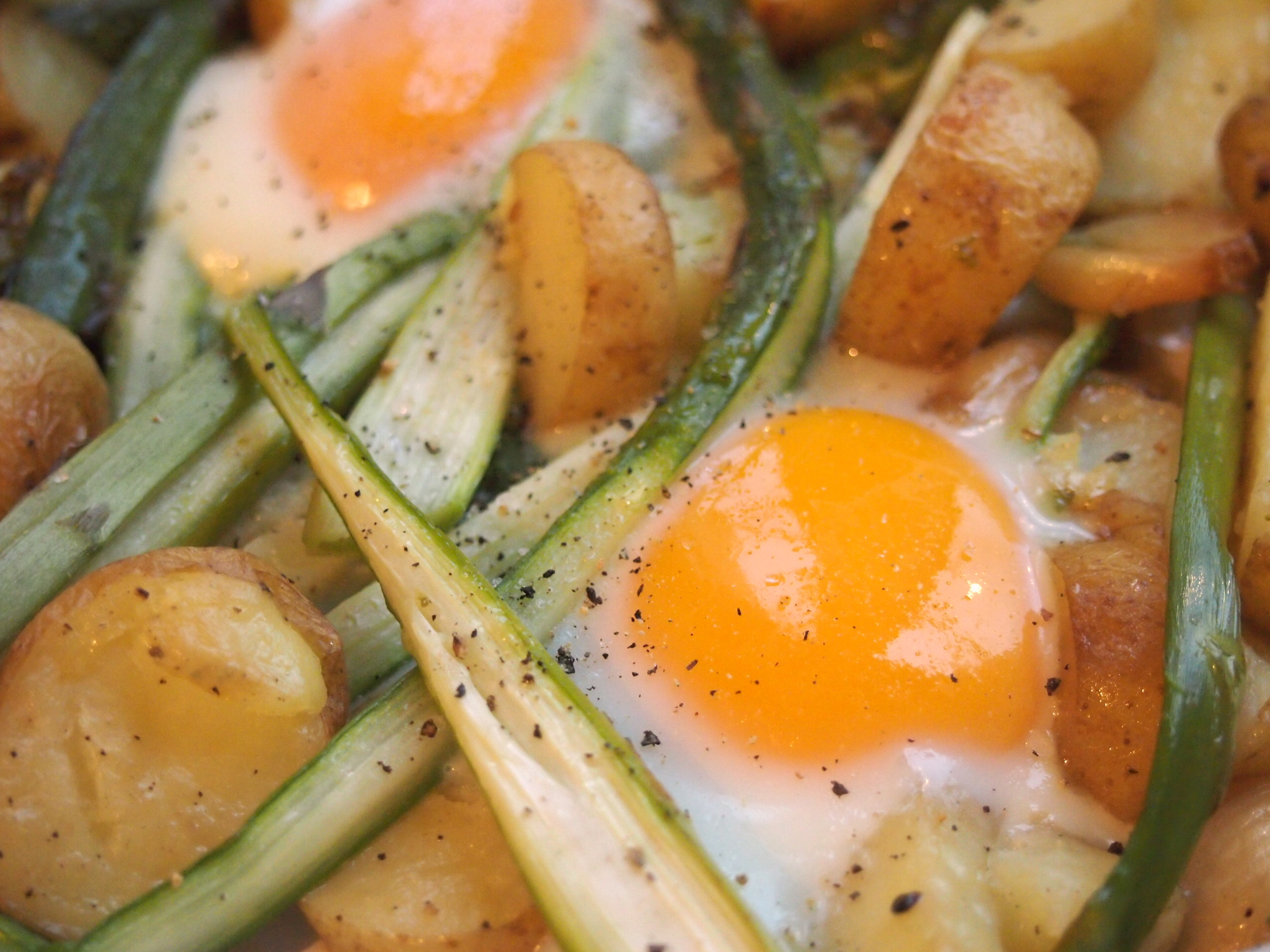
Summer is apparently today, with a whooping 23 oC expected… And, oh praise the Lord!, it is a not a weekday! Before rushing to the lake, my favourite recipe for this season… Have already done it several times this “spring”- not minor thing, considering I have a childhood trauma related to asparagus (swallowed hairpin, please ask my mother for details).
Roast new potatoes and asparagus with baked eggs (adapted from Hugh Fearnley-Whittingstall’s column in The Guardian)
Ingredients
- 600-700g new potatoes, cleaned and cut into small chunks
- 5-6 whole garlic cloves, bashed
- 3 tbsp olive oil
- Sea salt and freshly ground black pepper
- About 400g asparagus
- 4 eggs
Method
Heat the oven to 190 oC. Put the potatoes into a roasting dish with the garlic. Sprinkle over the oil, add plenty of salt and pepper, toss and roast for 30 minutes, until tender.
Meanwhile, snap the woody ends off the asparagus and cut the spears into 3-4cm lengths. When the potatoes are tender, add the spears, toss and roast for 15 minutes more, until the asparagus is tender.
Now create four little spaces among the veg for the eggs, arranging the potatoes and asparagus pieces into holes more or less stable. Working quickly, so everything stays hot, break an egg into each space, then return the dish to the oven for about four minutes, until the whites are set and the yolks still runny.
Sprinkle some salt and pepper over the eggs, serve.
Pain perdu with raspberries and ricotta
Posted: May 4, 2012 Filed under: Dessert, Eggs | Tags: bread, Dessert, Eggs, Milk, Sugar Leave a comment
Pain perdu literally means “lost bread” in French. As in the bread which you cannot eat while french and becomes stale. Probably during Roman times, a resourceful cook realized that if the bread was softened by dipping it in milk and/or eggs and then fried, it could be converted it into a delicious dish apt for all tastes. I grew up in Portugal eating it, as fatias douradas [golden slices] over Christmas, generously sprinkled with sugar and cinnamon. When I moved to Spain, I learnt their name was in fact torrijas and it would make its appearance later down the year during Lent. I am pretty sure if I bring this topic up in the office, Swiss and the Germans would claim to have their own variety of the dish. But, that belongs to another post… To close the debate, it might be worthwhile mentioning there is a considerable difference between fatias douradas, torrijas and pain perdu. The iberian varieties are deep fried, while the French opt for browning them with butter.
In any case, when I found an ancient panettone in the back of the cupboard, I remembered this recipe I had seen ages ago in a Gordon Ramsay’s book. It also had been a while ever since I used this book, and in fact, I even had a perfect group of [s]suffering guests[/s] testers coming home for brunch. Perfect occasion, perfect ingredients, perfect guests… As every Gordon’s recipe, if you follow the instructions to the letter, you will get exactly what you are supposed to get. Probably due to the differences in the ingredients, the raspberry mix got a bit messy, but nothing a pair of experienced hands couldn’t fix to the right consistency and taste. All in all, in almost less time than it took to cook it, not only I managed to get rid of old panettone but also had a very happy and satisfied crowd. Definitely calories worthwhile taking.
Pain perdu with raspberries and ricotta (adapted from Gordon Ramsay’s Fast Food: Recipes from The F Word)
Ingredients
- 125g ricotta cheese drained
- 125g mascarpone
- 2 tablespoons sugar
- 200g raspberries
- 25g butter
- 4 slices of panettone
- 3 large eggs beaten
Method
1. Put the ricotta, mascarpone, sugar and lemon juice in a bowl and mix until it is smooth. Fold half the raspberries and mix softly.
2. Put 1 slice of panettone in the egg mix and let it soak for a couple of minutes.
3. Fry the slice on both sides until golden brown (about a couple of minutes). Take it out of the pan and put it in a serving plate.
4. Repeat (2-4).
5. Put a generous spoon of the raspberry mix on top of the warm slices of fried panettone, and finish with the remaining raspberries.
6. Serve.
2. Melt the butter in a non stick pan until it begins to foam.
Sabih, tahini sauce, zhoug and salad
Posted: August 23, 2011 Filed under: Eggs, Salad, Vegetables, Vegetarian | Tags: Aubergine, bread, Eggs, Herbs, Salad, Spices, Tahini, Yotam Ottolenghi 1 Comment
An Israeli chef gives his interpretation of an Iraqi dish, topped with an Yemenite green chilli sauce. And, a pretty damn good it was, just ideal for this sort of weather…. The recipe was brought to the Guardian (here), by the hand of Yotam Ottonleghi. You know the drill: kilometric list of ingredients and several elements to put together at the end. But, it is worthwhile the effort – the combination of flavors and textures is delicate and at the same time exciting. Each one has its place and none is over-powering. It can be cooked in large batches and stored in the fridge to be eaten ad hoc.
Sabih, tahini sauce, zhoug and salad
Ingredients
For the sabih
- 2 large aubergines
- About 300ml sunflower oil
- 4 slices rustic white bread, toasted
- 4 free-range eggs, hard-boiled and cut into 1cm-thick slices
- Salt and black pepper
For the tahini sauce
- 100g tahini paste
- 80ml water
- 20ml lemon juice
- 1 small garlic clove, crushed
For the salad
- 2 ripe tomatoes, cut into 1cm dice
- 2 mini cucumbers, cut into 1cm dice
- 2 spring onions, thinly sliced
- 1½ tbsp chopped parsley
- 2 tsp lemon juice
- 1½ tbsp olive oil
For the zhoug
- For the zhoug
- 35g coriander
- 20g parsley
- 2 green chillies
- ½ tsp ground cumin
- ¼ tsp ground cardamom
- ⅛ tsp sugar
- ¼ tsp salt
- 2 garlic cloves, crushed
- 3 tbsp olive oil
- 2 tbsp water
Method
Using a vegetable peeler, peel off strips of aubergine skin from top to bottom, so they end up like a zebra, with alternating black-and-white stripes. Cut both aubergines widthways into 2.5cm-thick slices.
Heat the sunflower oil in a wide pan. Carefully – the oil spits – fry the aubergine in batches until nice and dark, turning once, for six to eight minutes; add oil if needed as you cook the batches. When done, the aubergine should be completely tender in the centre. Remove from the pan, leave to drain on kitchen paper, then sprinkle with salt.
To make the zhoug, put all the ingredients in a food processor and blitz to a smooth paste. For the tahini sauce, put the tahini paste, water, lemon juice, garlic and a pinch of salt in a bowl. Mix well, and add a little more water, if needed, so its consistency is slightly runnier than honey. Make the salad by mixing the tomato, cucumber, spring onion, parsley, lemon juice and olive oil. Add salt and pepper to taste.
To serve, place a slice of bread on each plate. Spoon a tablespoon of tahini sauce over each, then arrange overlapping slices of aubergine on top. Drizzle over some more tahini, without completely covering the aubergines. Season each egg slice, and lay on top of the aubergine. Drizzle more tahini on top and spoon over as much zhoug as you like – be careful, it’s hot! Serve the salad on the side; spoon a little on top of each sabih, too, if you like. Store any leftover zhoug in a sealed container in the fridge – it will keep for a week at least.
Rice and spinach cake
Posted: April 6, 2011 Filed under: Rice, Vegetarian | Tags: Eggs, Rice, Spices, spinach Leave a comment
While looking for a recipe to use up spinach, I found by chance an old rticle about rice by Fiona Becket. The recipe has proved to be ageless, and delicious. The quantities of herbs and spices had to be adjusted to current times – pinches are now teaspoons.
Rice and spinach cake
Ingredients
- 500g fresh, tender-leafed spinach
- 250g arborio or carnaroli rice
- 2 medium-sized onions
- 2 cloves garlic
- 25g unsalted butter
- 2 tbsp olive oil
- 3 fresh, well-born eggs
- 60g Parmesan, grated
- 2 or 3 sage leaves
- A pinch of thyme
- A pinch of oregano
- Sea salt
- A generous grating of nutmeg
Method
Pre-heat the oven to 200C/400F/gas mark 6. Wash the spinach several times in a sink full of cold water. Remove the stalks and imperfections from the spinach. Place a large pan of water to boil and plunge in the spinach. Quickly remove the spinach, cool in iced water and drain thoroughly. Rinse the pan, refill with water and return to the cooker to boil. Form the spinach into balls, squeezing out any excess water, then chop finely. Tip the rice into the boiling water and cook for 10-12 minutes. Drain the rice and mix with the spinach.
Peel, finely chop, and fry the onions in the oil and butter until pale and softened, then add to the rice and spinach. Pick and chop the herbs, peel and finely chop the garlic, grate in about 4 tablespoons of Parmesan, add in the eggs, sea salt and several grinds of pepper. Mix all this together, then smooth into a dish or a tin lined with liberally-buttered silicon paper. Bake the cake in the oven for 25-30 minutes until golden
 Lucie Loves Food