Pear and fennel salad with caraway and pecorino cheese
Posted: September 26, 2013 Filed under: Salad, Vegetarian | Tags: Cheese, Pear, Salad, Vegetarian, Yotam Ottolenghi Leave a comment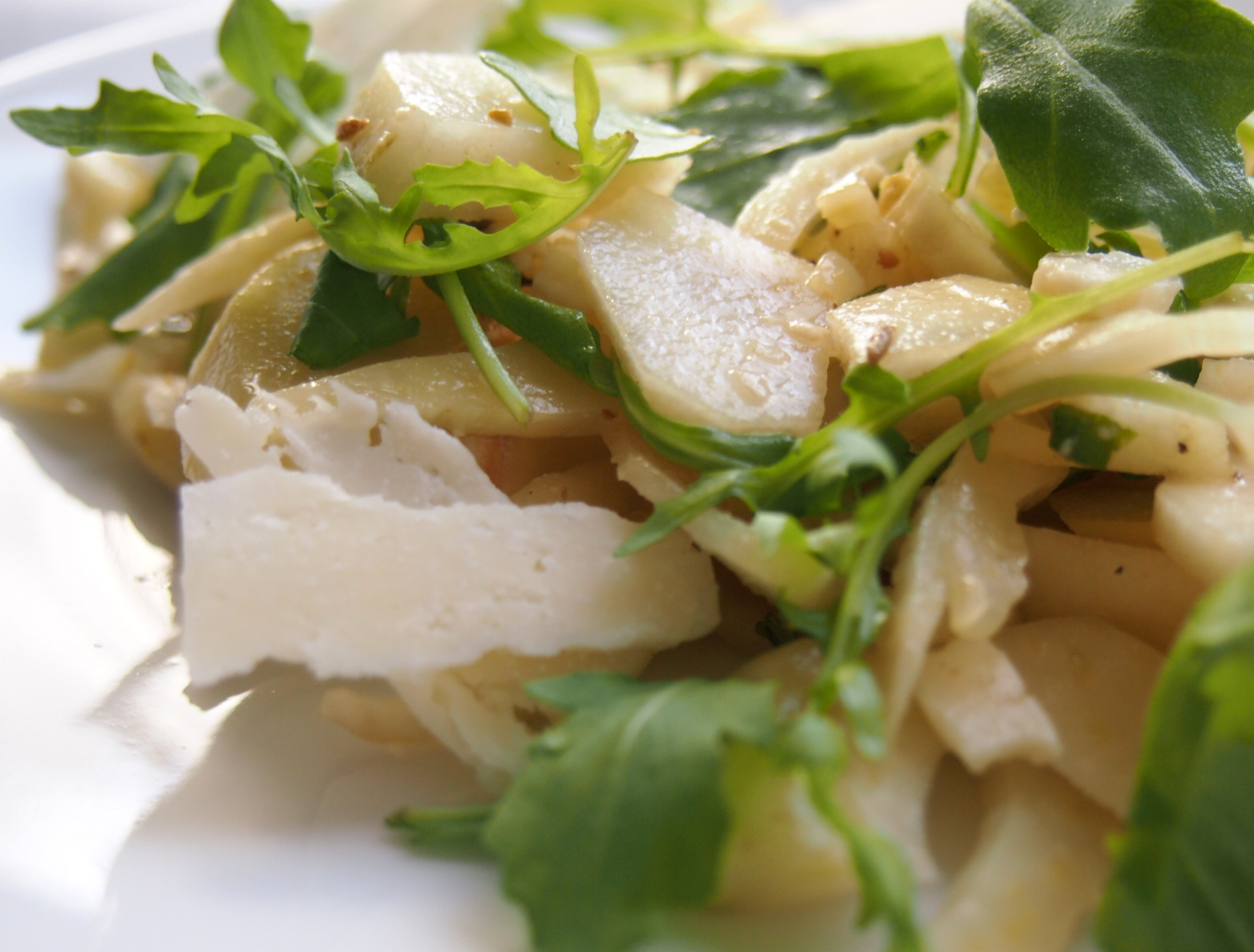
From an off-season salad to a totally in season one, courtesy of Yotam Ottolenghi. It seems an odd combination of flavours, but they really go well together: the anise flavor of the fennel, sweetness of the pears, the saltiness of the cheese, the freshness of the lemon, the bitterness of the rucola…. It could well be one of the dishes of this Autumn (minus pecorino cheese, for a sensible calorie count).
Pear and fennel salad with caraway and pecorino (adapted from Yotam Ottolenghi’s column in The Guardian)
Ingredients
- 3 tbsp lemon juice
- 1 tbsp sherry vinegar
- 1 large fennel bulb, cut in half lengthways, then each half cut sideways into 2mm slices
- 2 tbsp olive oil
- 1½ tsp caraway seeds, toasted and lightly crushed
- 1 tsp maple syrup
- Salt and black pepper
- 10g picked dill
- 75g rocket
- 3 medium ripe conference pears, peeled, quartered lengthways, cored and cut into 0.5cm wedges
- 60g pecorino, thinly shaved
Method
Mix the lemon juice and vinegar in a large bowl. Add the fennel and leave to soften for about 45 minutes, stirring from time to time.
Put the oil, caraway, maple syrup, a quarter-teaspoon of salt and some black pepper into a small bowl, strain in the lemon and vinegar from the fennel bowl and stir well.
Add the dill, rocket, pear and pecorino to the fennel bowl, pour on the dressing, toss lightly and serve.
Apricot, walnut and lavender cake
Posted: August 12, 2013 Filed under: Dessert, Fruit, Pastry and Baking, Vegetarian | Tags: Almonds, Apricots, Cake, Chestnuts, lavender, Sugar, Summer, Yotam Ottolenghi 5 Comments
It was love at first sight. And, timing couldn’t have been better. I was just looking for my annual super baking project when I bumped into this recipe. It was so delicious, I will have to bake it again. And again… and again. Never mind the Modern Art Cakes – this the one I want I want for my birthday. Truth to be said, it is not particularly difficult dish. But the flavours, oh!, the flavours…. It were layers upon layers of fresh, summery and nutty flavours, each mouthful different.
Apricot, walnut and lavender cake (adapted from Yotam Ottolenghi’s column in The Guardian)
Ingredients
- 185g unsalted butter, diced and at room temperature
- 2 tbsp walnut oil
- 220g caster sugar
- 120g ground almonds
- 4 medium eggs, beaten
- 120g ground walnuts
- 90g plain flour
- ½ tsp vanilla extract
- Grated zest of 1 lemon
- 1½ tsp picked lavender flowers, fresh or dry
- Salt
- 600g (gross) apricots, halved and stones removed
For the icing
- 50g icing sugar
- 1 tbsp lemon juice
Method
Heat the oven to 170C/335F/gas mark 3. Put the butter, oil, sugar and almonds in the bowl of a mixer and beat on a medium-high speed until light and fluffy. Add the eggs bit by bit, making sure each addition is well incorporated before beginning the next, then fold in the walnuts, flour, vanilla, lemon zest, a teaspoon of lavender flowers and an eighth of a teaspoon of salt.
Line the base and sides of a 23cm cake tin with greaseproof paper. Pour in the cake mix and use a palette knife to level it out. Arrange the apricot halves skin side down and slightly overlapping all over the top of the cake, taking them right to the edge.
Bake for 70-80 minutes – cover with foil if the top starts to brown too much; also, note that when you insert a skewer to test for doneness, it will come out a little sticky because of all the moisture in the apricots.
While the cake is baking, whisk together the icing sugar and lemon juice until you have a light, pourable icing (adjust the amount of sugar or juice slightly, to suit your tastes). As soon as the cake is cooked, remove from the oven and brush the icing all over the top. Sprinkle over the remaining lavender flowers and set aside to cool.
Savoury cookies with parlsey and tahini spread
Posted: June 30, 2013 Filed under: Pastry and Baking, Snacks, Tapas, Vegetarian | Tags: Cookies, Herbs, Snacks, Spread, Tahini, Tapas, Yotam Ottolenghi Leave a comment
B. was wondering what to do with a bottle of tahini he had sitting on his fridge. “What is this used for?”, he asked. “Oh, well, plenty of stuff like humus… and errrr… humus…. or even maybe carrot hummus, if you will“, I answered a bit mortified by the lack of options. Seriously, is tahini used just for hummus? After googling for a few minutes, it seems it also very popular in vegan cuisine, including lebanese inspired brownies (add beetroot for extra touch of healthiness), it is fundamental for baba ghanoush and the hero in all sorts of yoghurty-garlicky-herb-y dips. Like for example, this one I found in Jerusalem (but of course…). As a bonus, these savoury biscuits, a favourite of Yotam’s father. Totally addictive…
Savoury cookies with parsley and tahini spread (adapted from Yotam Ottolenghi and Sami Tamimi‘s Jerusalem)
Ingredients
Cookies
- 500g of plain flour sifted
- 100mL of sunflower oil
- 100 unsalted butter diced and left to soften
- 1 teaspoon of fast action dried yeast
- 1 teaspoon of baking powder
- 1 teaspoon sugar
- 1 1/2 teaspoon salt
- 1 1/2 teaspoon ground cumin
- 1 1/2 teaspoon fennel seeds toasted and very lightly crushed
- App 100mL of water
- 1 medium egg, whisked
- 2 teaspoon white (and black) sesame seeds
Dipping sauce
- 35g flat leaf parsley (stems and leaves)
- 1 garlic clove crushed
- 25g light tahini paste
- 125g Greek yoghurt (drained)
- 25mL lemon juice
- Pinch of salt
Method
Cookies
Preheat the oven to 200 oC. Place the sifted flour in a large bowl and make a well in the centre. Pour the oil into the well, add the butter, yeast, baking power, sugar, salt and the spices and stir together until the dough is formed. Add the water gradually while stirring until the dough is smooth. Knead for a couple of minutes.
Line a baking sheet with baking parchment. Divide the dough into small bowls, about 25g each. On a clean surface, roll the balls into long snakes, around 1cm thick and 12-15cm long. Make a closed out of each snake dough, and put on the parchment paper leaving a 2 cm distance between each of them. Brush each ring with the egg wash and sprinkle lightly with sesame seeds. Leave to prove for 30min.
Bake the biscuits in the oven for 22min, until golden brown. Allow to cool before storing. They will keep for 10days.
Dipping sauce
Blitz all the ingredients together to get a smooth, uniform green sauce you can use to coat the cookies. Add a bit more water if necessary.
Grapefruit and sumac salad
Posted: April 25, 2013 Filed under: Salad, Vegetarian | Tags: Grapefruit, Salad, Yotam Ottolenghi 2 Comments
My iPhone Samsung Galaxy Note, whom never lies, tells me today is going to be a nice sunny day. The tepid 24oC it promised, seems as good as an excuse as any other to together this lovely salad. It almost feels a bit too summery for the end of April, even. But when the sun is out you have to enjoy it while it is there. If it goes again, God only knows when it will be back. And, apparently, grapefruits are in season…
Pink grapefruit and sumac salad (adapted from Yotam Ottolenghi’s column in The Guardian)
Ingredients
- 5 pink or red grapefruits for the salad
- 300mL of grapefruit juice (a big one is suffice).
- 2 tbsp caster sugar
- 1 small dried red chilli
- 4 tablespoons olive oil
- 1½ tablespoons lemon juice
- 1 tablespoon sumac
- ½ red onion, peeled and very thinly sliced
- 2-3 small red chicory, separated, and large leaves cut in half on an angle
- 80g lamb’s lettuce (Valerianella locusta)
- Salt
Method
Top and tail five grapefruits so they’ll stand on a board. Cut down the side of each grapefruit, following its natural lines, to remove the skin and white pith. Over a bowl to catch the juices, cut in between the membranes to separate the individual segments. Dry the segments on kitchen paper and squeeze any juice from the skin and membranes into a saucepan.
Squeeze enough juice from the last grapefruit to make the juice in the pan up to 300ml. Add the sugar and chilli, bring to a boil, lower the heat and simmer until the sauce thickens and you have about five tablespoons-worth of juice left – this could take up to 20 minutes. Set aside to cool down, then whisk in the oil, lemon juice, sumac and a quarter-teaspoon of salt.
In a large bowl, put the grapefruit segments, onion, chicory, watercress and basil. Pour over three-quarters of the dressing and toss gently. (If it seems dry, add all the dressing; otherwise, save it in the fridge for another leafy salad.) Serve at once.
Kohlrabi salad
Posted: March 18, 2013 Filed under: Salad, Vegetables, Vegetarian | Tags: Kohlrabi, Middle East, Salad, Spices, Yotam Ottolenghi Leave a comment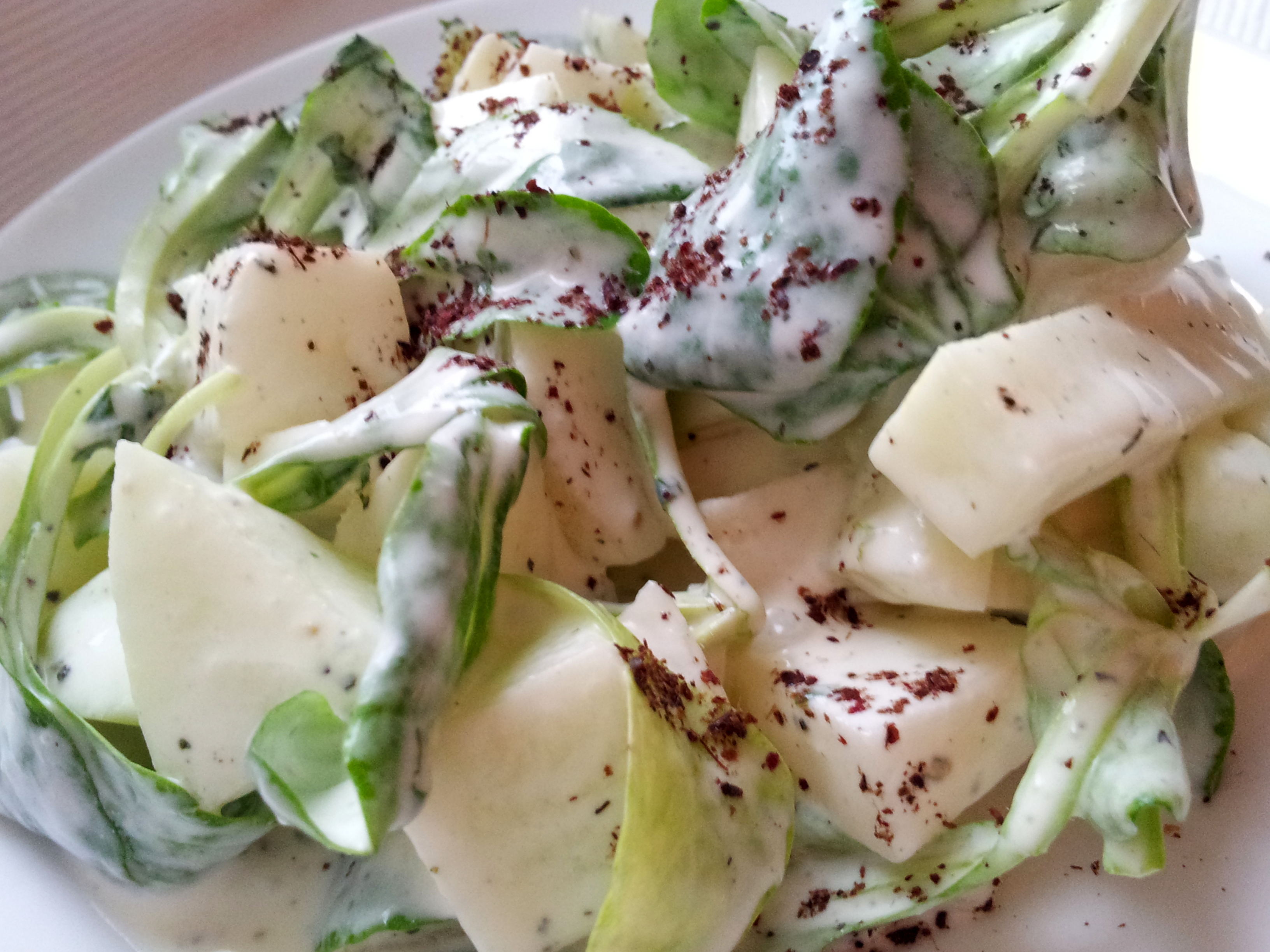
To my great dismay, I realized too late I have no Irish specialty to post on St Patrick’s day… After pondering for a few seconds, I decided to go for something green instead. All I had on the store was this Middle Eastern dish, found in Yotam Ottolenghi and Sami Tamimi‘s Jerusalem. A very unlikely combination, but nevertheless green enough. Happy St Patrick’s day!
Kohlrabi salad (adapted from Yotam Ottolenghi and Sami Tamimi‘s Jerusalem)
- 3 medium kohlrabies (about 750g)
- 80g Greek yoghurt
- 70g sour cream
- 5og thick double cream
- 1 small garlic clove, crushed
- 1 1/2 teaspoon lemon juice
- 1 tablespoon olive oil
- 2 tablespoon of finely shredded fresh mint
- 1 teaspoon dried mint
- 1/2 teaspoon sumac
- 20g Nüssli (Valerianella locusta)
Method
Peel the kohlrabis, cut into 1.5cm dice and put in a large mixing bowl. Set aside and start making the dressing.
Put the yoghurt, sour cream, double cream, garlic, lemon juice and olive oil in a medium bowl. Add salt to taste and a generous portion of freshly ground black pepper. Whisk well.
Add the dressing to the kohlrabi, followed by the fresh and dried mint, and halt nüssli, Gently stir and place on a serving bowl.
Drop what is left of the nüssli and sprinkle with sumac.
Quince poached in pomegranate juice and clotted cream
Posted: February 1, 2013 Filed under: Dessert, Fruit | Tags: Dessert, Fruit, pomegranate, Quince, Yotam Ottolenghi Leave a comment
I can remember those cooking marathons my Mother used to endure around Christmas time, when all the cooking would be put to an halt to produce countless pots of marmelada. Do not confuse with marmalada... Marmelada is a very sugary quincy purée, which is a staple in every Portuguese kitchen. It seems to be something the Romans learnt from the Greeks, and which staid with us until today,wikipedia dixit.
In any case, I would have thought to use the actual fruits for a dessert until I saw this recipe. And, I am glad I have tried it. Once you start with it, you just want to come back for more.
Quince poached in pomegranate juice (adapted from Yotam Ottolenghi’s column in The Guardian)
Ingredients
- 2 large quinces, peeled and quartered
- 800ml pomegranate juice
- 70g caster sugar
- 1 vanilla pod, cut in half lengthways and seeds scraped out
- The shaved peel of 1 large orange, plus 50ml juice
- 2 whole star anise
- 65g pomegranate seeds
- 120g clotted cream
- 2 tsp fresh mint leaves (optional)
Method
Core the eight quince quarters. Discard four cores and tie the others into a bundle with an old tea towel or muslin. Put the cored quince quarters into a heavy-based pan and add the wrapped-up cores, pomegranate juice, sugar, vanilla pod and seeds, orange peel and juice, and star anise. Bring to a boil, turn down to a gentle simmer, cover and cook for 15-25 minutes, until the quince is soft.
Remove the quince quarters with a slotted spoon and set aside. Simmer the sauce for 20 minutes or so, until it’s thick, syrupy and reduced to about 75ml. Just before serving, squeeze all the thick juices out of the core bundle into the sauce, then discard along with the orange peel, star anise and vanilla. Return the quince to the syrup and gently warm through. Place two quarters of quince on each plate, pour over some syrup and serve with clotted cream and a sprinkle of pomegranate seeds and shredded mint (if using)
Fancy coleslaw
Posted: January 29, 2013 Filed under: Salad, Vegetarian | Tags: Salad, Yotam Ottolenghi Leave a comment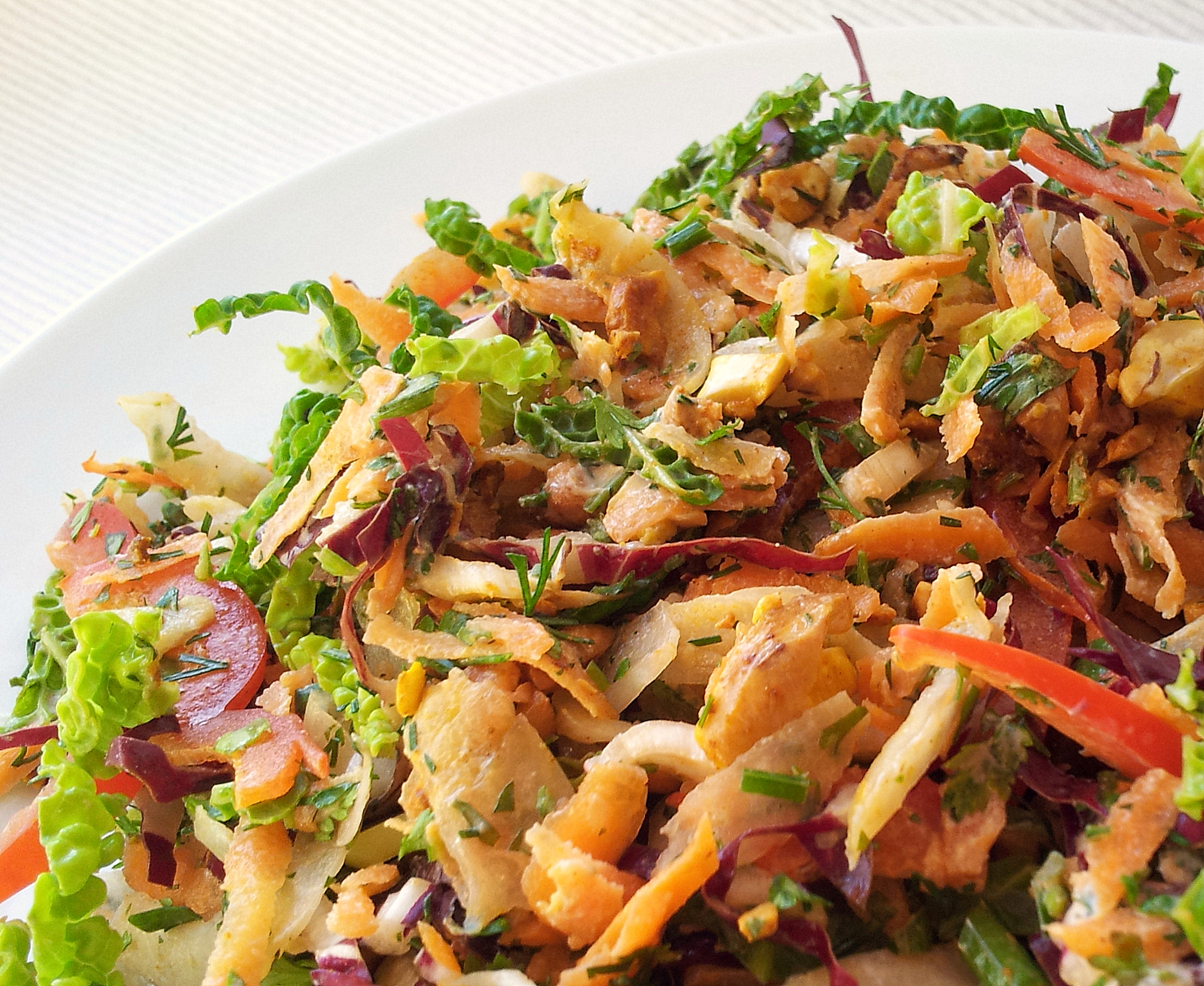
And, after #beetrootgate, back to Yotam Ottonlenghi’s alternative Christmas menu… Truth to be said, this was coleslaw was put together by Todpop’s. A lot of shredding, chopping and mincing, but the result was worthwhile. As Yotam promised, the perfect side dish to get a break from Christmas sugary-starchy-deepfried-ish tradition.
Fancy coleslaw (adapted from Yotam Ottolenghi’s column in The Guardian)
Ingredients
For the salad
- 2 medium carrots, peeled and julienned
- 1 medium fennel, trimmed and shredded 3mm thick
- 4 tbsp lemon juice
- ½ savoy cabbage, shredded 3mm thick
- 1 large radicchio, shredded 3mm thick
- 1 small red pepper, seeds removed and thinly sliced
- 1 red chilli, thinly sliced
For the dressing
- 100g Greek yoghurt
- 40g mayonnaise
- 1½ tsp dijon mustard
- 1½ tsp honey
- 1 tbsp olive oil
- 30g parsley, chopped
- 20g dill, chopped
- 10g tarragon, chopped
- Salt and white pepper
For the spiced cashews
- 120g cashew nuts, roughly chopped (or other toasted nuts)
- ¾ tsp ground turmeric
- ¾ tsp ground cumin
- 1½ tsp ground paprika
- ¾ tsp caster sugar
Method
For the spiced cashews
Heat the oven to 160C/320F/gas mark 2½.
place in a small bowl the cashews, turmeric, cumin, paprika, sugar and an eighth of a teaspoon of salt. Stir through a tablespoon of water so the spices cling to the nuts, place on a baking tray and roast for 10-12 minutes, until golden and crunchy. Remove and set aside to cool.
For the salad
In a large bowl, mix the carrots, fennel and two tablespoons of the lemon juice. Set aside for 20 minutes, drain in a sieve over the sink and leave to strain.
Return the strained carrots and fennel to the bowl, add the cabbage, radicchio, red pepper and chilli, and stir well.
For the dressing
For the dressing, whisk together the yoghurt, mayonnaise, remaining lemon juice, mustard, honey, olive oil, a quarter-teaspoon of salt and an eighth of a teaspoon of white pepper. Pour this over the vegetables and mix well. Add the herbs and spiced nuts, stir to combine and serve
Sweet spiced duck breast with beetroot and ginger relish
Posted: January 15, 2013 Filed under: Duck, Vegetables | Tags: Betroot, Duck, Spices, Yotam Ottolenghi 1 Comment
The moment I saw this Yotam Ottonlenghi’s alternative Christmas menu, I knew I had to do it. It didn’t take too long to convince three mobile calorie intake units friends to join me in cooking duck for the first time in years this journey. Lucky ladies – it was probably the best meal I cooked this year… As usual, Yotam instructions were so precise that even duck seems easy to cook.
What I could not anticipate was the several dishes of beetroot which followed this one. After an unfortunate chain of events, otherwise known as #beetrootgate, I ended up with a lot – and when I say a lot I really mean a lot – of beetroot in the fridge. Enough to keep this blog busy for the next couple of weeks…
A big thank you to T., my suffering sous-chef for this menu.
Sweet spiced duck breast with beetroot and ginger relish (adapted from Yotam Ottolenghi’s column in The Guardian)
Ingredients
For the duck
- 4 duck breasts, 800g in total
- 1 tsp ground star anise
- ½ tsp ground cloves
- 2 tsp sunflower oil
- Salt and black pepper
For the beetroot relish
- 6 medium beetroots, peeled and sliced 1mm thick
- 300ml red-wine vinegar
- 200g caster sugar
- 1 tsp flaked chilli, or more if you like it spicy
- 15g peeled ginger, finely grated
- 1 tsp black mustard seeds
- 4 sprigs fresh thyme, plus extra for garnish
- 2 bay leaves
- 6 Sichuan peppercorns
Method
Score the duck breasts in three or four parallel lines on an angle across the skin, taking care not to cut through to the meat. Place them in a medium-sized bowl and add the star anise, cloves and oil. Rub the spices into the duck so the breasts are well covered, cover the bowl and refrigerate for an hour or two.
Meanwhile, make the relish. Mix all the ingredients in a large saucepan and add a teaspoon and a half of salt. Bring to a boil and stir to dissolve the sugar. Reduce the heat to low, and simmer for 40-50 minutes, stirring occasionally, until the beetroot becomes tender, the liquid thick and all but reduced entirely. Remove from the heat and set aside somewhere warm.
Heat the oven to 200C/390F/gas mark 6, and heat a large, heavy-based frying pan on medium heat. Add half a teaspoon of salt and a quarter-teaspoon of black pepper to the duck breast bowl and mix well. Place the breasts skin side down into the hot pan – you won’t need any oil because of the amount of fat in the duck skin – and cook for four to five minutes, regularly spooning out the fat that’s released into the pan. If the skin is getting too dark too quick, lower the heat a little.
Once the skin is a dark golden-brown and crisp, turn over the breasts and sear on the flesh side for three minutes.
Transfer the breasts to a baking tray and finish cooking in the oven for about three minutes, until cooked to medium. Remove from the oven, cover with foil and leave to rest for five minutes.
To serve, slice the breasts on an angle and lay on a plate. Spoon some beetroot relish on to each breast and pour over a little of the syrup. Scatter a few thyme leaves on top and serve immediately
Roasted pumpkin wedges with dill sour cream
Posted: September 29, 2012 Filed under: Vegetables, Vegetarian | Tags: Cheese, Herbs, Pumpkin, Yotam Ottolenghi 3 Comments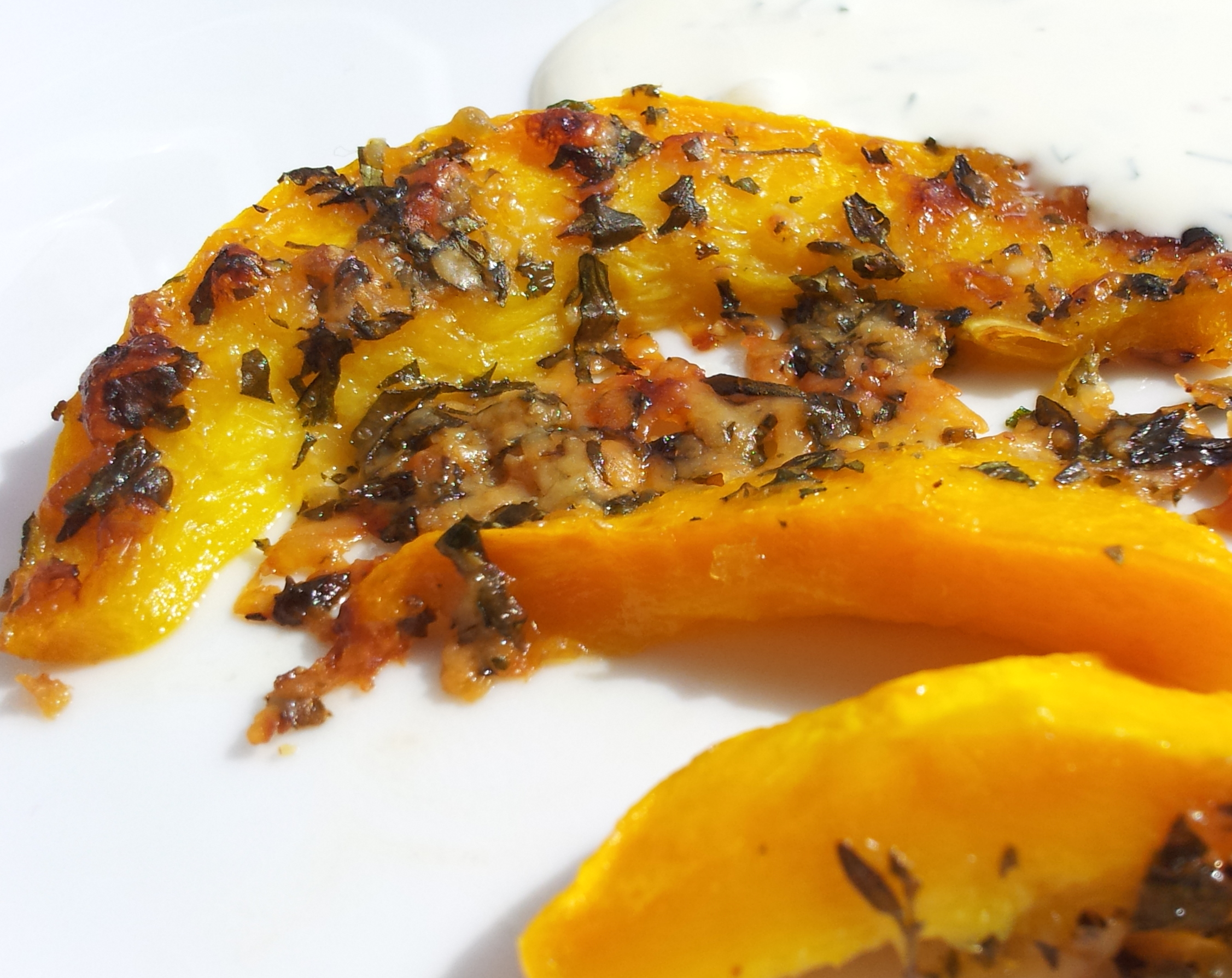
The good thing is that this is a delicious pumpkin dish. The bad one, that Autumn is here. I somehow feel I didn’t had enough of Summer. From here to Christmas is only a small leap. Thank God for the produce of the season to help me cross this bridge…
Roasted pumpkin wedges with sour cream (adapted from Yotam Ottolenghi’s Plenty)
Ingredients
- For the wedges
- 1 pumpkin (about 700g), desseeded pumpkin, and cut 1 about 2cm slices, skin on
- 50g grated Parmesan
- 3 table spoons of finely chopped thyme
- 6 table spoons of parsley
- the grated zest of 2 lemons
- 2 crushed garlic cloves
- Enough olive oil to brush the pumpkin wedges
For the dill sour cream
- 12o mL of sour cream
- 1 tablespoon of chopped dill
- salt and withe pepper
Method
Pre heat the oven to 190 oC.
Slice the pumpkin, keeping the skin. The wedges should be about 2 cm thick .
Lay the pumpkin wedges on a tray lined with baking parchment and brush them with olive oil
For the crust, by mix in a small bowl the Parmesan, the chopped parsley and thyme, the lemon zest, the garlic and some pepper (check for salt. Normally you won’t need to add it as the Parmesan is salty enough).
Sprinkle generously the wedges, with the crust mix.They should all be covered with a few millimeter layer of crust. If the
Put in the oven and roast for 30min or until the wedges are soft and tender. If the topping starts to get too dark, cover the tray with foil
In the meanwhile, start the dill sour cream. Mix all the ingredients (sour cream dill, salt and pepper).
You can serve it warm or cold (better warm…)
Marinated mozzarella and tomato
Posted: August 4, 2012 Filed under: Salad, Vegetarian | Tags: Herbs, Mozzarella, Salad, Summer, Tomato, Yotam Ottolenghi Leave a comment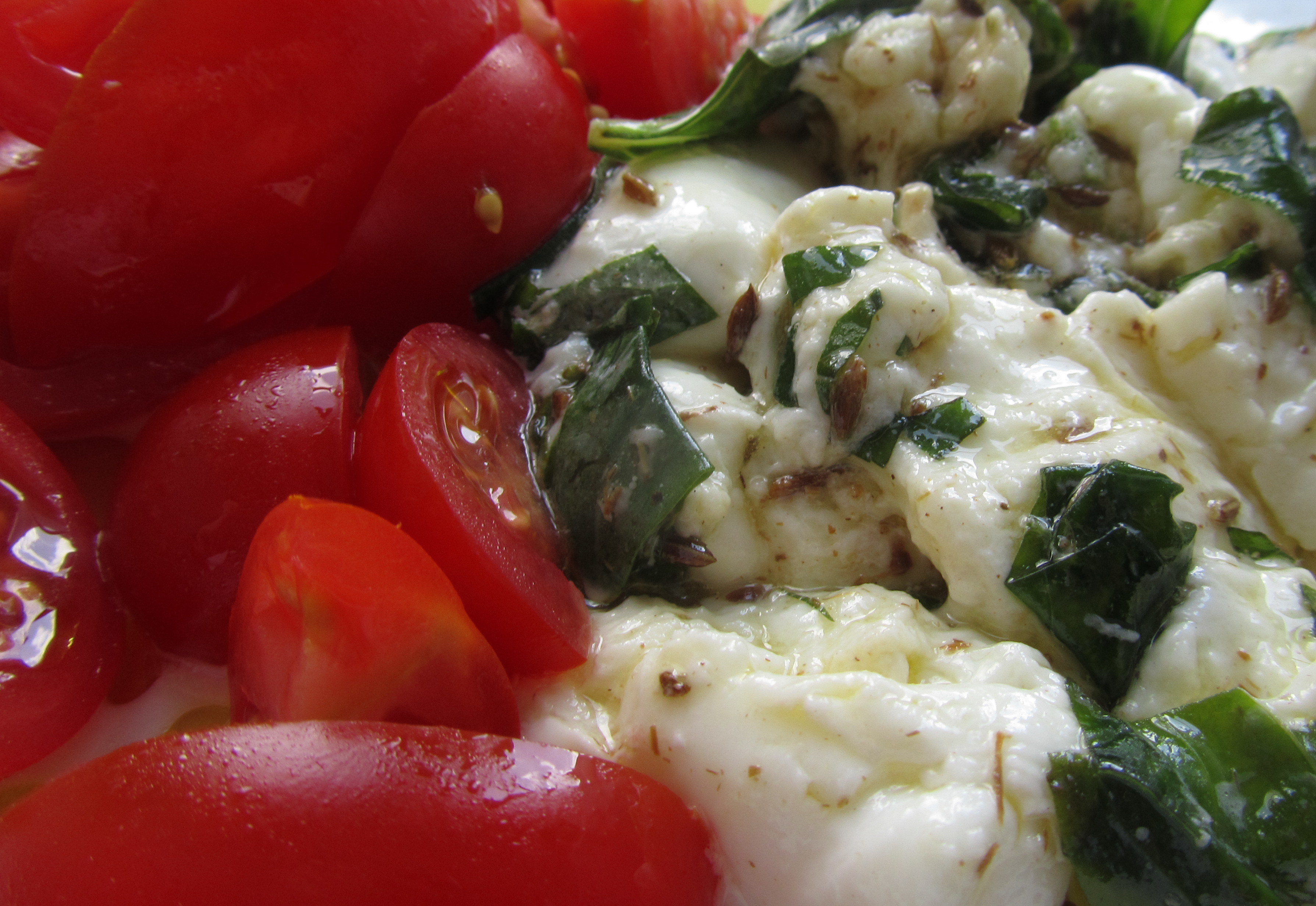
If you had lived in Zurich for long enough, you will have quickly learnt that if the sun is out, you have to leave home and in enjoy it while it is there. God only knows when you will be able to enjoy again walking down the street without having to resort to several layers of clothing. It could be next day, but it can also be in a week, in a month or next year (if ever!). This Summer, it was even more extreme than usual. After a few weeks of sheer desperation, we found ourselves enjoying each quasi-summer day like it was the last one. And, many times it seemed like that indeed it was, and that we all would be condemned to an existence plagued with cashmere cardigans, heavy scarfs and thick stockings…. So, in a nutshell – there was not really a lot of opportunities for cool dishes. Except, maybe this one, from Yotam Ottolenghi’s Plenty. An italian classic, converted into a ubiquitous dish:tomato-mozzarella-basil dictatorship. But, this one has a twist – roasted fennel seeds – which makes it outstanding. Not the usual watered stuff you get so often here in Zurich…
Marinated mozzarella and tomato (adapted from Yotam Ottolenghi’s Plenty)
Ingredients
For the salad
- 250g mozzarella (use buffalo mozzarella for best results)
- 4 ripe tomatoes, cut in wedges
For the marinade
- 1/2 tablespoon of crushed roasted fennel seeds
- grated zest of 1 lemon
- 15 basil leafs shredded
- 2 tablespoons of chopped oregano
- olive oil to taste (or a mix 1:1 of olive oil and rapeseed oil)
- 1 garlic clove crushed
- salt and pepper to taste
Method
For the marinade
First, put the fennel seeds in a small frying pan and heat until they start to pop. Drop them in a mortar and grind them until you have a chunky powder.
Combine all the marinade ingredients in a small bowl and mix well. Drop in the shredded mozzarella (shred the cheese and the basil with your hands, for an extra touch of rusticity).
Set aside for a about 20min
For the salad
In a plate, put the marinated cheese and the tomatoes side by side. Drizzle with a bit more olive oil, if necessary and serve.
 Lucie Loves Food