Crushed courgettes and roasted chicken
Posted: September 26, 2011 Filed under: Chicken, Vegetables | Tags: Courgette, Garlic, Herbs, Masterchef Australia, Yotam Ottolenghi, Zucchini Leave a comment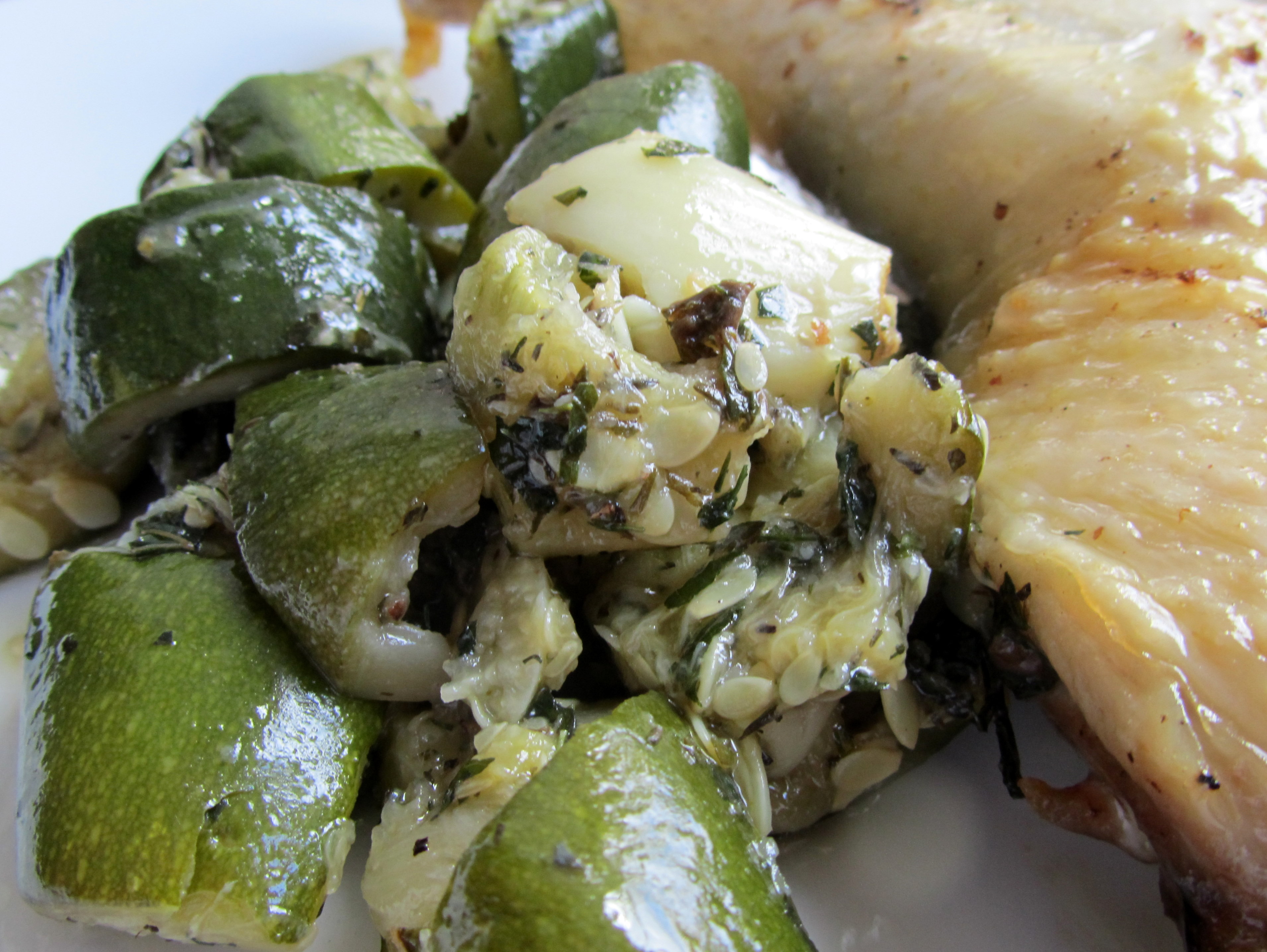
In a couple of weeks, courgettes’s season will be almost over. But, for the time being, we still can find them at the supermarket screaming to be cooked with loads flavors to soak up. For example – garlic, thyme and mint, as in this crushed courgettes dish Yotam Ottolenghi created for The New Vegetarian.
To go with the courgettes, nothing better than a roasted chicken. For this one, I used a very basic recipe I saw on Masterchef Australia (with a couple of tweaks).
Crushed courgettes
Ingredients
- 3 large courgettes (750g), cut in half lengthways and then into 6cm pieces
- 1 whole garlic bulb, separated into unpeeled cloves
- 1 tsp dried mint
- 3 sprigs fresh thyme
- 1½ tsp coarse sea salt
- Black pepper
- 70ml olive oil
- 2 tbsp chopped fresh mint
- 1½ tbsp chopped dill
- 1 tbsp lemon juice
Method
Heat the oven to 200C/400F/gas mark 6. Put the courgettes and garlic cloves in a bowl and add the dried mint, thyme, salt, some black pepper and the oil. Mix everything together and transfer to a medium baking dish – make sure the courgette pieces overlap a little, cut side up, and form a single layer. Bake for about 40 minutes, until the courgettes have softened and taken on some colour.
Transfer everything to a colander, pressing the courgettes so they start to release some of their liquid, and leave to cool for at least 30 minutes.
Transfer the contents of the colander to a mixing bowl, and squeeze the garlic cloves out of their skins (discard the skins). Mash everything together with a fork (if the courgettes’ skin is on the tough side, you may have to chop them with a knife). Stir in the remaining ingredients and set aside for an hour before serving.
Roasted chicken
Ingredients
- 1 chicken, broken down into legs & breasts still on the bone
- 8 sprigs of rosemary
- Olive oil
- Salt and pepper to taste
Method
Preheat the oven at 220oC
Cover the bottom of a roasting tray with olive oil. Put the chicken into the tray skin, with the side up in one evenly spread layer.
Pat the chicken skin with a paper towel until it is dry. Sprinkle evenly with salt and pepper and drizzle with olive oil. Put the rosemary on top of the chicken pieces.
Put the tray into the oven, and cook the chicken for about 35min.
Sabih, tahini sauce, zhoug and salad
Posted: August 23, 2011 Filed under: Eggs, Salad, Vegetables, Vegetarian | Tags: Aubergine, bread, Eggs, Herbs, Salad, Spices, Tahini, Yotam Ottolenghi 1 Comment
An Israeli chef gives his interpretation of an Iraqi dish, topped with an Yemenite green chilli sauce. And, a pretty damn good it was, just ideal for this sort of weather…. The recipe was brought to the Guardian (here), by the hand of Yotam Ottonleghi. You know the drill: kilometric list of ingredients and several elements to put together at the end. But, it is worthwhile the effort – the combination of flavors and textures is delicate and at the same time exciting. Each one has its place and none is over-powering. It can be cooked in large batches and stored in the fridge to be eaten ad hoc.
Sabih, tahini sauce, zhoug and salad
Ingredients
For the sabih
- 2 large aubergines
- About 300ml sunflower oil
- 4 slices rustic white bread, toasted
- 4 free-range eggs, hard-boiled and cut into 1cm-thick slices
- Salt and black pepper
For the tahini sauce
- 100g tahini paste
- 80ml water
- 20ml lemon juice
- 1 small garlic clove, crushed
For the salad
- 2 ripe tomatoes, cut into 1cm dice
- 2 mini cucumbers, cut into 1cm dice
- 2 spring onions, thinly sliced
- 1½ tbsp chopped parsley
- 2 tsp lemon juice
- 1½ tbsp olive oil
For the zhoug
- For the zhoug
- 35g coriander
- 20g parsley
- 2 green chillies
- ½ tsp ground cumin
- ¼ tsp ground cardamom
- ⅛ tsp sugar
- ¼ tsp salt
- 2 garlic cloves, crushed
- 3 tbsp olive oil
- 2 tbsp water
Method
Using a vegetable peeler, peel off strips of aubergine skin from top to bottom, so they end up like a zebra, with alternating black-and-white stripes. Cut both aubergines widthways into 2.5cm-thick slices.
Heat the sunflower oil in a wide pan. Carefully – the oil spits – fry the aubergine in batches until nice and dark, turning once, for six to eight minutes; add oil if needed as you cook the batches. When done, the aubergine should be completely tender in the centre. Remove from the pan, leave to drain on kitchen paper, then sprinkle with salt.
To make the zhoug, put all the ingredients in a food processor and blitz to a smooth paste. For the tahini sauce, put the tahini paste, water, lemon juice, garlic and a pinch of salt in a bowl. Mix well, and add a little more water, if needed, so its consistency is slightly runnier than honey. Make the salad by mixing the tomato, cucumber, spring onion, parsley, lemon juice and olive oil. Add salt and pepper to taste.
To serve, place a slice of bread on each plate. Spoon a tablespoon of tahini sauce over each, then arrange overlapping slices of aubergine on top. Drizzle over some more tahini, without completely covering the aubergines. Season each egg slice, and lay on top of the aubergine. Drizzle more tahini on top and spoon over as much zhoug as you like – be careful, it’s hot! Serve the salad on the side; spoon a little on top of each sabih, too, if you like. Store any leftover zhoug in a sealed container in the fridge – it will keep for a week at least.
Chicken and buttermilk cold soup
Posted: August 17, 2011 Filed under: Chicken, Soup | Tags: Chicken, Herbs, Lemon, Soup, Spices, Yotam Ottolenghi 2 Comments
Mafalda, a 6-year-old Argentinian girl, who is deeply concerned about humanity and world peace, loves The Beatles and rebels against the current state of the world, hated soup. Totally and vehemently. And, her dislike of soup appears to have been transmitted to her fans, including myself. Not until recently I have started to appreciate soup. I might eat a mean gazpacho in the peak of Summer, but I used to welcome soup with the same enthusiasm than a double root-canal. Even away from my parent’s home, I could hear my Mother said “Oh, but is so healthy, it has so many vitamins and minerals…”. Probably today, she would have said something around the lines of “it has loads of antioxidants…” But, over the years my culinary tastes have changed, and I came to appreciate it. In Winter, a rich soup a rich soup nourish the soul and comfort the body. In Summer, it can be cooling and refreshing. At the end, it seemed to be our parents were right about it.
Before Summer is over, I decided to give it a go to this chicken and buttermilk soup I saw on The Guardian. Dishes by Yotam Ottolenghi very-very-rarely goes wrong, and this Summer soup looked refreshing, velvety and packed with different flavors and textures. I was not disappointed. In fact, I might even start to serve in Winter, to remind me of the long lost Summer.
Chicken and buttermilk cold soup
Ingredients
- 3 tbsp olive oil, plus extra to finish
- 1 large onion, chopped into 2cm dice
- 3 small whole garlic cloves, peeled
- 4 free-range chicken drumsticks or thighs, skinned
- 2 small potatoes, peeled and cut into 2cm chunks
- Zest of 1 lemon, half of it shaved into strips, the rest grated
- Salt and white pepper
- About 800ml chicken stock
- 250ml buttermilk (or whole milk)
- 15g each fresh basil, coriander and mint leaves, roughly shredded
- ½ tbsp sumac
Method
Heat two tablespoons of oil in a large saucepan and sauté the onion and garlic on a low heat for five to 10 minutes, until soft but not coloured. Add the chicken, potatoes, lemon strips, a teaspoon of salt and half a teaspoon of white pepper. Pour in stock just to cover and simmer gently for 30 minutes, until the potatoes are soft and the chicken is cooked.
Remove and discard the lemon strips, and transfer the chicken to a bowl. Blitz the soup until smooth and leave to cool down. Once cool, stir in the grated lemon zest and buttermilk. Taste, adjust the seasoning, and refrigerate until cold. Take it out of the fridge about 20 minutes before serving, so it’s chilled but not fridge-cold.
Just before serving, shred the chicken off the bones, and fry the shredded meat in the remaining olive oil on a high heat until golden and crispy. Divide the soup among the bowls, add the shredded chicken and herbs, drizzle with oil, sprinkle with sumac and serve.
If you want to serve it as a hot dish, warm it up very gently after stirring in the buttermilk, to avoid curdling
Spiced lentils with cucumber yogurt
Posted: April 4, 2011 Filed under: Pulses and lentils, Vegetarian | Tags: Cucumber, Lentils, Spices, Yoghurt, Yotam Ottolenghi 1 Comment
Spiced lentils with cucumber yogurt
Ingredients
- 200g split red lentils
- 1 bunch fresh coriander
- 1 small onion, peeled
- 40g ginger, peeled
- 3 cloves garlic, peeled
- 1 mild green chilli
- half teaspoon of black mustard seeds
- 4 tablespoons of sunflower oil
- half teaspoon ground coriander
- 1 teaspoon ground cumin
- half teaspoon ground turmeric
- half teaspoon paprika
- 10 curry leaves
- 300g ripe tomatoes, peeled and chopped
- 2 teaspoon caster sugar
- half teaspoon fenugreek (optional)
- 1 pinch asafoetida (optional)
- Salt
- 150g Greek yogurt (I used regular lactose free yogurt)
- 75g finely diced cucumber
- half tablespoon of olive oil
- 70g unsalted butter
- lime juice
Methods
Wash the lentils in plenty of water, drain and soak in 350ml of fresh water for 30 minutes. Cut the coriander bunch somewhere around its centre to get a leafy top half and a stem/root bottom half. Roughly chop the leaves. Put the stem half in the bowl of a food processor, add the onion, ginger, garlic and chilli – all roughly broken – and pulse a few times to chop up without turning into a paste.
Put the mustard seeds in a heavy-based pot and place over medium heat. When they begin to pop, add the onion mix and sunflower oil, stir and cook on low heat for 10 minutes. Add the spices and curry leaves, and continue cooking and stirring for five minutes longer. Now add the lentils and their soaking water, the tomatoes, sugar, fenugreek, asafoetida and a pinch of salt. Cover and simmer for about 30 minutes, until the lentils are fully cooked.
Before serving, whisk together the yogurt, cucumber, oil and some salt. Stir into the lentils the butter, lime juice and chopped coriander leaves, taste and season generously with salt. Divide into bowls, spoon yogurt on top and garnish with coriander.
Leek fritters.
Posted: March 27, 2011 Filed under: Vegetables, Vegetarian | Tags: Fritters, Leeks, Spices, Yoghurt, Yotam Ottolenghi Leave a comment
A Yotam Ottolenghi‘s family dish, with its usual kilometric list of ingredients and a recommendation: do not skip any of them. If anything, spare yourself the bother of doing the sauce. Recipe was found on Plenty, his latest cookbook.
Ingredients
For the sauce
- 100g Greek yogurt
- 100g sour cream
- 2 garlic cloves, crushed
- 2 tablespoons lemon juice
- 3 tablespoons olive oil
- salt to taste
- 20g finely chopped flat-leaf parsley leaves
- 30g finely chopped coriander leaves
For the fritters
- 3 leeks (450g trimmed weight)
- 2 banana shallots, peeled and finely chopped (I used regular red onions)
- 140ml olive oil
- 1 red chilli, deseeded and sliced
- 25g parsley, finely chopped
- 1 teaspoons coriander seeds, crushed
- 1 teaspoons ground cumin
- ½ teaspoons ground turmeric
- ½ teaspoons ground cinnamon
- 1 teaspoons sugar
- salt to taste
- 1 egg white
- 120g self-raising flour (or regular all purpose flour with 2 teaspoons of a raising agent, like Royal).
- 1 tbsp baking powder
- 1 egg
- 150ml milk
- 55g unsalted butter, melted
Method
Start by making the sauce. Put all the sauce ingredients into the bowl of a food processor, blitz together until a uniform green, then set to one side.
Cut the leeks into 2cm thick rounds, rinse and dry. Over medium heat, sauté the leeks and shallots in a pan with five tablespoons of oil until soft – about 15 minutes – then transfer to a bowl and add the chilli, parsley, spices, sugar and salt. Leave to cool.
Whisk the egg white to soft peaks and fold it into the vegetables. In another bowl, mix the flour, baking powder, egg, milk and butter to form a batter. Gently mix this into the egg white and vegetable mixture.
Put two tablespoons of oil in a frying pan over medium heat. Spoon the mixture into the pan to make four large fritters, and fry for two to three minutes a side, until golden and crisp. Transfer to kitchen towel and repeat, adding oil as needed, until the mixture is used up. Serve warm with the sauce on the side or drizzled over.
The ultimate Winter couscous
Posted: November 30, 2010 Filed under: Grains, Pulses and lentils, Vegetables, Vegetarian | Tags: Apricots, Carrots, Chickpeas, Couscous, Parsnips, Pumpkin, Roast, Spices, Yotam Ottolenghi Leave a comment
Tomato galette, take 2
Posted: September 19, 2010 Filed under: Pastry and Baking, Vegetarian | Tags: Goat cheese, Tomato, Yotam Ottolenghi Leave a comment
Tomato galette and roasted spring onions
Posted: September 1, 2010 Filed under: Pastry and Baking, Vegetarian | Tags: Goat cheese, Spring onions, Tomato, Yotam Ottolenghi Leave a comment
The spring onions’ recipe is a courtesy of T.. The tomato galette was a creation of Yotam Ottolenghi for his New Vegetarian column on The Guardian.
Tomato Galette
Ingredients
- 375g all-butter puff pastry
- 8 stalks fresh oregano, leaves picked and roughly chopped
- 100g goat’s cheese, crumbled
- 450g red, yellow or green tomatoes of various sizes, sliced 2mm thick
- 8 stalks fresh thyme
- Olive oil
For the sundried tomato paste
- 10 sun-dried tomatoes from a jar
- 1 fresh red chilli, sliced (I use a tea spoon of dried piri piri)
- 2 garlic cloves
- Half tablespoon of sugar
- 1 teaspoon of salt
Method
Preheat the oven to 200oC/gas mark 6. Roll out the pastry to 3mm thick (Alternatively, if you have a large enough baking sheet, roll out the pastry into one circle, like a big pizza.) Transfer the pastry rectangles to a large baking sheet lined with baking paper and refrigerate for 30 minutes.
Meanwhile, make the sun-dried tomato paste. Put all the ingredients in the small bowl of a food processor and process to a rough paste; if necessary, add a little oil from the tomato jar to bring it together. If your food processor bowl is too large, you may need to do some of the chopping by hand.
Spread a thin layer of the tomato paste over the chilled pastry, leaving a border about 1cm from the edge. Sprinkle with the oregano and goat’s cheese, and arrange the tomatoes on top, slightly overlapping but not too precisely. Make sure the tomato paste is covered by fresh tomatoes because it tends to burn. Drop the thyme stalks over the tomatoes and drizzle with a little olive oil.
Bake for 15 minutes, until golden on top; check the base to make sure the pastry is brown and fully cooked. Remove from the oven and leave to cool before drizzling over more olive oil and serving warm.
Roasted spring onions
Ingredients
- Spring onions, cut in half
- Salt, pepper
- Olive oil
Method
Preheat the oven to 200oC. Put the Spring onions on a baking tray. Sprinkle with salt and pepper, and then drizzle with a little olive oil. Bake for 10 minutes or until golden on the top.
 Lucie Loves Food